Tag: Costa Rica adventures

  • Best places in Costa Rica – our guide

    Best places in Costa Rica – our guide

    We have finished our romp around Costa Rica, covered nearly a 1000km in total, and dropping in on the main attraction centres, so here is a quick run through the main towns we stayed and what we thought of them.

    Costa Rica is a really young country, unlike other countries it didn’t have a notable civilisation like Aztecs, Mayans or Incas, without a civilisation with an abundance of riches to plunder, the Spanish conquistadors didn’t show it much interest and neither did the Catholic church.

    Consequently, there isn’t much history to look at anywhere, but its attraction is the biodiversity and coastline. There is hardly anything over 150 years old, so in some ways it is like being in the United States or Australia, but their indigenous people still have a deep relationship with nature, hence their strong commitment to conservation, a little bit similar to New Zealand and the Māori tribes.

    The Costa Rican people are very friendly, helpful and they are proud to tell you they are one of the happiest nations on earth. With this in mind I was a bit perplexed as to why their homes all seem to have quite extreme levels of security. Nearly all of their homes have bars on their windows or bars around their walls. It isn’t uncommon to see broken glass on the tops of walls to stop people climbing over them or even razor wire along the tops. The only place where I have seen security like that was in South Africa and it transpires that the petty crime rates are high and tourists are the main targets, or anyone who is perceived to have wealth. With this in mind, we shouldn’t have been surprised to have all our money stolen on the beach at Uvita.

    First stop was San Jose, the capital, most people land and move on, but we decided to give it a day to see what it was like.  To be honest, everyone else was right as there is nothing much to see here at all, other than wandering around two dull markets to get over your jet lag. We chose a hotel halfway between the airport and the city centre called the Country Inn Radisson. I thought being halfway between the city centre and the airport would give us the best of both worlds, but it just gave us heavy traffic in both directions.  Having spent our last night at the airport Hilton I’m glad to report it wasn’t such a bad decision, Hampton by Hilton San Jose Airport was very poor for our last night, rubbish breakfast and very basic.

    Verdict – don’t bother and avoid

    Second stop on the itinerary was Porto Viejo. This is in the far southeast on the Caribbean coast on the border with Panama. You will not end up here unless you are heading to Panama or make a conscious decision to go out of your way to see it.  About an hour away the highway hits the Caribbean and runs alongside it for the rest of the journey.

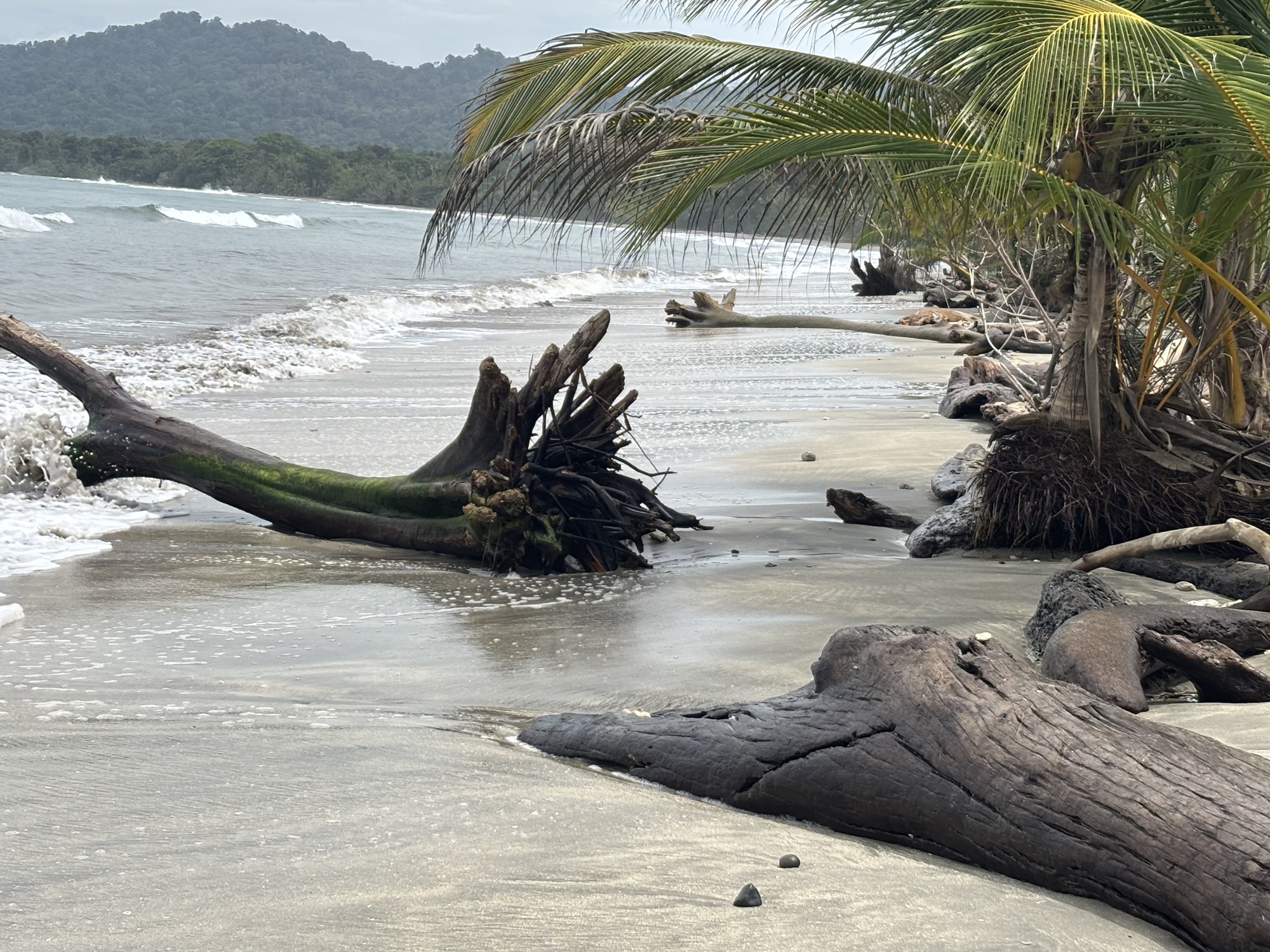
    At this point you start to relax and feel the vibe, there are the odd small settlements along the way that sets the scene but when you arrive in Porto Viejo you feel like you have arrived on a little Caribbean Island, there is just a rough road through the town, a few beach shops, cafes and bars on one side with palm trees and a surf beach on the other side, it was like my idea of heaven.

    We stayed here for 4 nights at the Cariblue Beach and Jungle Resort which was the real deal in terms of environment impact. Everything was built from wood, it processed its own water, and the lodges were surrounded by jungle, Wooksie was alarmed being that close to nature as it bites, but decent insect repellent kept things under control. Within the resort we had Howler Monkeys screaming over our heads and all sorts of other creatures around us, not to mention the amazing moment when we found the sloth on the ground outside our lodge. 

    Our view from the bedroom window – real jungle

    We did the jungle kayak ride and walk, and to be honest, we saw more animals on this cheap half day trip than pretty much all the other trips put together. We also did the Cahuita National Park which was disappointing as we only saw a couple of  Cappuccino monkeys but the thing that kept me most entertained was walking along the deserted beach, admiring the jungle on one side and surf on the other side, then finishing the day in the bar on the beach drinking cocktails and waiting for the torrential rain that arrived every night.

    Verdict – A wonderful place, an idyllic Caribbean beach vibe but off the beaten track

    Next stop was La Fortuna. This was a long trek and from the Northwest from the Southeast of the country. La Fortuna itself is a bit of a one horse town that has been growing, apparently the tarmac on the roads was only laid recently. There is a main street with bars and restaurants for travellers but that is about it, so people are here to do fun stuff not to see the town.

    The main attraction is the Arenal Volcano, but also the Rain Forest and a range of activities that have built up around them.  Trekking on the volcano is limited because it is active, so you have just got to hope you get lucky and have a decent view, which we did. We also did the hanging bridges, which are a really impressive piece of engineering, the extreme zip wire tour, the La Fortuna Waterfall and volcano hike.

    The only thing we didn’t do was the hot springs, but as our second hotel had a swimming pool heated by the hot spring we don’t feel we missed out on much and we happen to own a Hot Tub at home!

    We had a dilemma regarding Monteverde, which is the other main town which we wanted to visit in the region. It is a very difficult route from La Fortuna, and we didn’t have a 4×4, it offers almost the same types of activities but at a higher altitude in Cloud Forests, based on chatting with local guides, we decided to give it a miss, and I think we made the right decision on that one. To be honest the jungle walks were disappointing to be honest but that is nature. We did all the activities we planned at La Fortuna in 1 ½ days, so 2 days is enough here, and I spent the third day catching up on blogs ½ creating videos.

    Lots of traveller’s head for Manuel Antonnio, which is at the southern tip of the popular tourist route. We drove through it on the way to Uvita. It seemed busy and congested but it was difficult to tell, there was lots of tourist activity going on as it is a major centre for travellers. We, however, were heading to Uvita to spend a week with our daughter who was volunteering in a hostel.

    We stayed at two different hotels.  The first was the Secreto La Fortuna, which was tucked away in one of the side streets and offered really good access to the town and tour pickups. It had a nice pool and even had its own resident sloth in the tree above reception.

    The second hotel was Hotel Lomas del Volcán which was recommended by a friend. It was a totally different resort experience outside of the town, it even had Its own nature walk in the surrounding jungle. The problem with a resort is that you need your own car to get to town, or you have to stick with the resort facilities. I wasn’t too impressed with the building noise but that’s life. What was impressive was the hotel swimming pool that was heated by the volcanic streams, it is the hottest pool I have ever been in.

    Verdict – Essential as part of any Costa Rican holiday

    Next stop was Jaco Beach. After Porto Viejo this was our favourite resort. It is the closest resort to San Jose, so it is very popular with locals rather than tourists, though it is also popular for US short breakers.  It is little more than a busy high street; it was the only place we saw the big US food chains like KFC in Costa Rica.

    There is a fabulous sandy beach that is around 5km long and has surf breaks and board rental stalls on the beach, various beach bars for watching the beautiful sunsets and kids playing football on the beach. It was at Jaco we realised that nearly all the resorts seem to have the same offerings in terms of trips, zip wires, nature, quad bikes, white water rafting and waterfalls.

    We stayed in the resort twice on our trip. The first time going south, we stayed at a lovely place called Hotel Ibiza which had a mock Greek feel to it, was located 100m from the northern end of the beach and was very friendly. On the second visit we stayed at the south end of the beach because the surf breaks are better, and I didn’t want to have to walk the length of the beach to go surfing.

    The second time we stayed at the Laguna Resort and Beach Club. Talk about a fantastic location, I walked out from the hotel, picked up the board and walked straight into one of the best long board waves I’ve ever surfed. If anyone wants to learn to surf this is the place to do it, the conditions are nearly perfect. The hotel wasn’t as nice as Hotel Ibiza but for location, wow.

    Verdict – make it a priority – a wonderful beach and plenty of things to do

    Uvita is nothing more than a pit stop on the way to Panama and not a normal traveller location. It is about an hour south of Manual Antonio and is a mecca for whale watching scuba diving and surfing in the Uvita National Park. It has a huge beach, and a unique headland called the Whale Tail due to its shape, so people tend to come here from other resorts for the activity and then leave again. Hence it is quiet in the evenings but at least there is space in the little selection of restaurants.

    The major blot on our Uvita visit was having all our money stolen from our bag on the beach, in hindsight, we had to take a lot of responsibility for our own stupidity, and we were very lucky not to lose a lot more than cash. Our robber was clearly benign because he left everything other than the cash, if he (or she) had taken the cards and phone we would have been in serious crisis.

    We were here for 6 nights at that Yuli Hotel, which was very nice and happily very reasonable as well, with a nice pool and friendly staff. Some nights they also had a lively restaurant with great chilled house music playing. There is a lot of development work going on and I suspect 3 years from now it will have expanded a lot and will grow like La Fortuna.

    Verdict –  it’s a one night  place if mixed with an activity like whale watching

    Our last stop was Porto Jimenez on the OSO peninsula. This was another 2 hour drive south and around 25% of the Costa Rican biodiversity is on display here, if you can find it. We planned to take the road around the peninsula, but when we got arrived it became obvious that we needed a 4×4 to get anywhere, and we had a Nissan saloon, so it didn’t end well.

    The peninsula is big, and the roads are rough and full of big potholes, so we gave up, we had hoped to walk to the national park along the coast from Port Jiminez but there was no route through the jungle, so again we were stumped.

    The thing about this area is that hotels on the peninsula are hugely expensive, most of them are around £1000 per night but that wasn’t an excuse for our hotel, which wasn’t cheap, but hotel was a shocker, Cabinas Agua Luna Frente al Mar as well.

    The roads were impassable, there were no nature walks from the town and the hotel was at the end of their little airport runway, so the whole thing was looking like a disaster. However, it was saved by a little beachside restaurant where we were treated to the best meal of the holiday and when the dogs woke us up at 530am we had a great experience watching parrots and toucans on our beach sidewalk.

    Verdict – research and plan your trip.

    I hope this summary of our itinerary proves a useful reference point if you chose to do a similar trip, if we can provide any more help, please contact me on email fun@rarefutures.com
  • Scuba Diving in Uvita: A Thrilling Adventure Awaits

    Scuba Diving in Uvita: A Thrilling Adventure Awaits

    Costa Rica Dive - refresher lesson pool

    Our final adventure for this trip was scuba diving. There are a few dive places in Costa Rica and the Canos Island off Uvita is one of them. It has the added benefit of a boat trip across the straights that are used by the migrating humpback whales with Costa Rica Dive

    I was looking forward to leisurely trip out to the island a mile or two off the beach, so the powerboat ride came as a bit of a surprise !

    I first tried Scuba diving on the Great Barrier Reef off Cairns back in 1997. It was such wonderful experience I came to the decision that it I would never dive anywhere better than there, especially in the cold waters off the UK, so I parked my interest in Scuba diving and was happy with the memories. It is also a very expensive sport, so when travelling with kids and on a budget, it was never high on the priority list so we would always go snorkelling anyway.

    That changed when we visited Zanzibar in 2024, despite its beauty and a great hotel, I still got bored after a few days, so I invested in a Scuba introduction course and 4 escorted dives. It was a fabulous experience, heading out to deserted atolls and reefs in an old fishing boat, and then diving down into the coral and swimming with the fish rather than watching from the surface. I was hooked and committed to doing the PADI open water certificate as my next challenge.

    high speed dive boat, Uvita

    Surprisingly it went completely out of my mind until I got to Uvita and saw the dive trips advertised. As with many things in Costa Rica it is priced for the American market and at $299 was an expensive day out, but I decided to give it a go.  I was anticipating another pleasant day out, plenty of sunshine, a few whales and lots of fish on the coral at Canos Island, about an hour out to sea.

    Things started to go wrong back in our room; I dug out the GoPro to take diving and discovered my battery charger was broken and I didn’t have the cable for the camera itself so wouldn’t be able to use it. Which left me with my little Go Pro camera which only works at depths of up to 10m, and we would be going down to 15m so it could be a problem. You will be surprised to know that I thought, “Pah what is the worst that can happen” and decided to chance it.

    First surprise was to wake up at 5am for the trip to find lashing rain and howling wind. Not quite what I was bopping for, but this wasn’t enough to deter the dive trip operators, so we marched to the beach from the dive centre, for boarding onto one of the high powered speed boats bucking around in the surf. Loading the boats wasn’t straightforward either, we had two groups, helpfully named Boat 1 and Boat 2, by the time we got to the beach we had become the names of the boats, so people in Boat 2 had to get into the boat called Mako Shark. I had missed this bit of nuance somewhere as it had been announced in Spanish, so we all assembled on the beach ready for something to happen. One group headed towards the surf, and one didn’t move, feeling a lost soul, I decided to follow the group to the beach as the leader was with that group.

    We all marched towards the surf behind the rather disorganised leader, but when we got there, he then noticed that only one group had followed him to the waters edge, the other group were still 300m away stood by the trees. There was then a lot of waving and shouting in the wind, before the aforesaid leader had to run all the way back up the beach to collect to explain to the second group they needed to follow him. While he was away, I asked another one of the dive blokes what was going and solved the problem of which boat I was in, I was in the Mako Shark.

    Dive boat launch, Uvita

    Next surprise was on the boat, which was evidently a high speed launch. We all put on our life jackets, were warned not to put our hands over the side, then the skipper hit the throttle and we accelerating to high speed, like some sort of drug smugglers escaping from the feds.

    Canos Island route map

    As you can see, Canos island is not exactly off the coast of Uvita, it is about 50km south and well out to sea, so no either def we were in a hurry.

    High speed boat transfer

    Out we went through the choppy seas with lots of airborne moments reminiscent of power boat racers. We quickly sped past the island I thought we were going to and headed out into the Pacific Ocean, where we were lashed by rain and wind. Not only that, but we also had our dentures loosened by the high speed crashing of the hull as it bounced off the swell, if there were any whales around, they would have dived out of our way. This was not the relaxing experience I had in Zanzibar for sure and my Garmin watch was tracking our speed at 40kph.

    After about 45 minutes we saw a distant island and 75 minutes the skipper throttled back and soon we were ready to dive.  After going through the laborious process of putting all the gear on, and armed with my GoPro camera, I flipped back over the side of the boat ready to explore the deep.

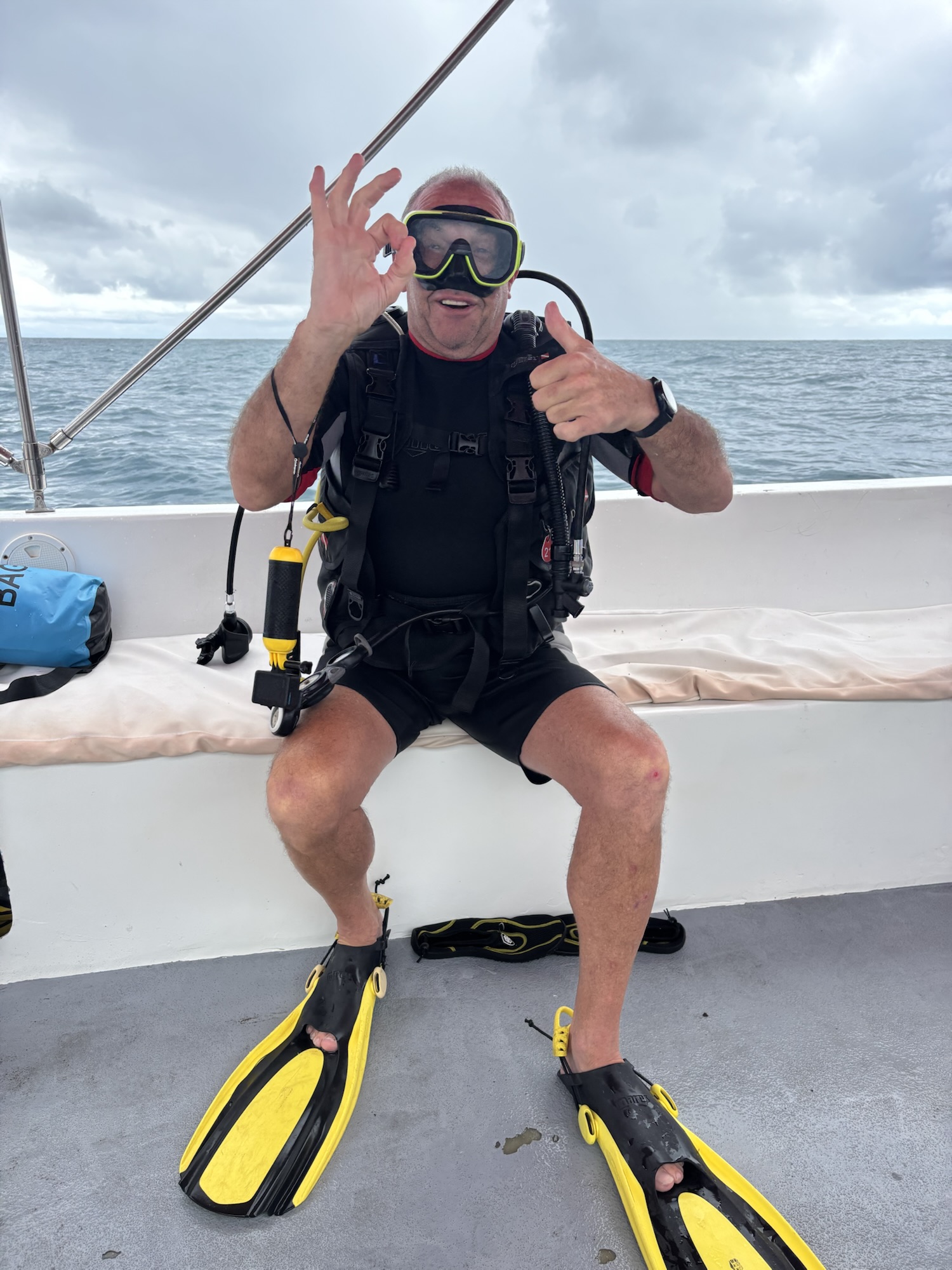
    A diver on a boat, wearing scuba gear and fins, giving an 'okay' hand sign while sitting on the boat deck.

    First dive into the depths

    The next surprise was in the water. Once I organised myself and looked around, I noticed there was no fish or reef but there was a buoy with a long rope. The purpose of this rope was to pull ourselves down to the depths where the reef and the fish was lurking, so down I went pulling myself down by the rope, with the other divers. Suddenly my GoPro camera came to life and started filming, which I thought was very clever so I waved it around filming anything that moved, but then a big red sign popped up to say I was too deep and it was warning me it would not work, and promptly switched itself off – great.

    The first dive was pretty good, and I achieved a big ambition, to see a shark in the wild. In fact, I saw 2, one swam past giving us a shifty look, and the other shark was having a kip on the ocean floor. The other big sighting on the first dive was the giant turtles, these really are magical creatures that look like rocks until they move. This is also their mating season and we were giving a grandstand view of a couple of giant turtles fornicating in the deep, it didn’t last long as the male fell off, but they seemed to have had a good time and the male set off in hot pursuit of his mate with enthusiasm.

    Giant sea turtle

    Second dive on to the reef

    Dives only last for 45 minutes and as our oxygen started to run low, we headed back to the boat for the obligatory rest and to clear our lungs before we can dive again. We all loaded back on the boat clumsily in our scuba gear and chatted about what we had seen, my group had been lucky compared to the other group which hadn’t seemed to see anything, but that is the way of nature.

    A compilation of of clips from the reef

    There are many lessons to be learned about nature, and a new one raised its head.  On the boat trip out we had been bumped around a lot which stimulated the desire to pee but didn’t really have an opportunity, then we had gone down into the depths in our wetsuits where our bodies were under pressure, and now we all needed a pee, quite desperately in some cases.  

    An unexpected problem

    The skipper spotted the problem and said that if we needed a pee, take the wetsuit off (apparently, they smell) and jump over the side to do our business. Within seconds the boat was covered in the discarded wetsuits, and the sea was full of people trying to have a pee but failing.  We then learned a bit about biology, we normally have the assistance of gravity when we pee, but in the sea it isn’t there as we are suspended, added to that our core muscles are busy stopping us drowning, so it is like trying to pee whilst doing a sit up in a gravity free zone – basically it is a very difficult thing to achieve to any level of satisfaction so we continued only marginally relieved, so to speak.

    waiting to dive
    We all needed a pee but didn’t like to say

    After our contortions, we reboarded the boat, kitted up and were back in the water for our second dive. Same process, grab the rope and down we went on a different bit of the reef. The difference was that on this dive it was our turn not to see anything. We were initially greeted by a shoal of fish that looked like zebras, so it started well, but didn’t get any better as we swam around for 45 minutes in the equivalent of subterranean desert, there were amusing moments as various members of our group floated away and had to be rescued by the guide, but to be honest I was getting a bit bored and spent more time focused on trying to have another pee, so was glad to come up in the end.

    Back on the boat, the other group had lots of stories about their sightings and generally started getting on my nerves. The truth of the matter was that we had a disappointing day with water based nature, possibly due to the rough weather that had sent the fish off to somewhere else. We then had a very nice lunch on the boat, inevitably a burrito and fruit, but it was much appreciated. I noted that people weren’t drinking much, which might have been on account of most of them still needing a pee.

    Before we knew it we were crashing our way back along the coast through raging storms, no sign of whales, and the dramatic arrival at the beach, the skipper didn’t even break from our 40kph before he did the waterborne equivalent of a handbrake turn when we were about 50m from the beach,  in a spellbinding manoeuvre that dumped us back on dry land before we knew it.

    Lessons from the trip

    So, I learned a few lessons from this:

    Costa Rica dive team
    1. Check how far out to see the reef is, because an hour in a chugging fishing boat is lot different to doing it in a power boat.
    2. How deep is the reef, because the bright lovely coral I saw as a snorkeller is only a few metres deep, when you get to 10m the sun is missing to the coral is going to be dull, if it exists at all.
    3. Check that you have the all the GoPro cables before you leave home and don’t break the ones you have.
    4. Don’t wear your Garmin watch when diving, despite it being guaranteed to 50m, something happened on the dive at 12m, and it is now written off.

    I have now promised myself that I will be going on an adventure to get my Open Water certificate, this is the same promise I made to myself last year, but I really mean it this time.  

  • Driving in Costa Rica: Navigating the Challenges

    Driving in Costa Rica: Navigating the Challenges

    Typical costa rican road

    I’ve now completed the travelling, so it is a good opportunity to talk about the main issues of getting around. The options are limited. Fly, bus or car, so I decided to rent a car, all the advice seemed to suggest the roads were safe and it would give us the independence with our travel schedule – and that proved to be correct.

    It’s not for the nervous to be honest, driver or passenger, and you need a sense of humour to survive the jams. Generally, this has all worked out well, but a couple of the days we’ve spent driving have been pretty tough.

    Don’t be put off, driving is generally safe and you be fine.

    Some of the roads are great and others are disaster zones, the problem is you don’t know which or when a good road will completely lose it’s covering and become gravel or convert from a motorway into a single lane back road.

    Country road in costa rica

    Some of the things that we didn’t expect include:

    1. Satnav – Apple Maps doesn’t work at all, luckily Google Maps does but it gets lost easily. We’ve been sent all over the place unnecessarily, especially in remote locations. Sending us down dead end roads and then halfway down telling us to do a u turn. It often thought the best route through a remote village was to turn off the highway, go down the back lanes and rejoin the highway again half a mile ahead.
    2. Lorries – There are giant lorries everywhere, it is their only form of logistics, and they take up a full 50% of the road, when they pass another lorry in the other direction, there is probably a max of 1m of space between the vehicles, so it is tight.
    3. Unmarked speed humps and by potholes – they were probably marked at some stage but the yellow colour has gone so they are sleeping saboteurs. Unexpected bangs and bounces are never more than a few seconds away.
    4. Lane widths, apart from being narrow, and having to watch out for lorries in particular, the edge of the carriageway is often the edge of the embankment and if a wheel goes over the edge the drop can be anything from 0.5m to 3 or 4 m, basically if you go off the edge you are stuffed.
    5. Road markings – these are range from brand new to nonexistent, but mostly the latter. On older roads they have normally been worn out, and on new surface they seem to have given up, so there aren’t any. I didn’t try it, but driving at night must be an absolute horror show.
    6.  Drains and Culverts – they run their drains and culverts down the sides of roads, so even if you are not on an embankment, it is not safe to pull of the road as there could be a deep drain or just an inspection hole, either way you are going to have a bad bump.
    7. Petrol stations – there are plenty of them, probably about 25 miles apart on the main roads and they all have the same prices. They are also quite nice places, with toilets and a shop. They have an attendant that fills up the car with fuel.
    8. Motorways -there is only one and that is currently being constructed between Limon and San Jose. This is a horror show as they are building it on the existing road so. At anytime you could be travelling along a brand new dual carriageway and then come around a bend to find a huge queue as you hit the next construction sight, which will also involve you hitting lots of potholes and craters.
    9. Junctions – as the roads seem to have no lines, junctions seem to have no rules. No one is going to give way, but then they also seem to be waiting for something to happen, so I just took the initiative did the turn and waved apologetically to everyone !
    10. One-way bridges – these are a hoot as you can see from the image. As you travel along a main road at 100kph you will suddenly come across a bridge which is one way at a time. So you suddenly have to stop and wait for a gap in the oncoming traffic. These are everywhere in the country and seem to be the source of most of the major traffic jams, as there is no way around them.
    Roadside dangers, Costa Rica

    So, in summary, driving is OK as long as you have strong nerves, have a sense of humour, don’t have a nervous passenger, and you are not on a tight schedule. A lot of the Costa Rican cars that you see appear to date back to the 90s, newer cars seem to be rentals, and the rest are 4x4s of various vintages.

    A quick summary of our trips.

    1. San Jose to Port Viejo (Green route)– we were grateful that we had a day off as this was a tough trip, not helped by it being a national holiday. It was around 218km, should have taken 4 but it took 6.5 hours. Getting out of San Jose with Google Maps was bad enough, then there is the road through the mountains which seems to be a graveyard for broken down lorries. After that you hit the road to Limon which is being turned into a motorway while you are on it and as Limon is a major port, it is also full of container lorries. Finally, you hit the road that runs along the Caribbean coast down to Porto Viejo. That road is a lot easier, but it is still slow because every 10 minutes you are confronted by a narrow bridge and a contraflow system for traffic.
    2. Porto Viejo to La Fortuna (Blue route) – unfortunately this involved the bad bits from the San Jose trip until you reach Squirres, where the San Jose traffic turns off and you head north. The bad news is that it is along the first of the narrow carriageways we had come across, and these are often raised. Overtaking is very difficult, so you end up sitting behind a lorry and letting that driver take the strain. When the road swung west towards La fortuna at Guipiles, things got easier and we had wider as we ran through the foothills of the Arenal Volcano, this journey should have been 4.5 hours, and not surprisingly, it took us over 6 hours to cover the 277km
    3. La Fortuna to Jaco Beach (Black route) – well this one really did take the prize, 142km but the warning sign from Google Maps was it would take 3.5 hours weaving across the mountains. What we didn’t expect was to pass through a cloud forest at the highest point and have roads that were only partially surfaced. I don’t know if this was Google Maps being weird, but we went over some remote mountains and at times felt very lonely and lost. When we did finally rejoin civilisation, we discovered that people had been killing each other in cars and we joined a 2 hour queue because of a major accident, so we finally made it to Jaco after nearly 7 hours to cover 142k, so an average speed of 20kph, or 12mph. By this time, Wooksie, my long suffering wife, was on the edge of a nervous breakdown trying to follow Google Maps.
    4. Jaco Beach to Porto Jiminez via Uvita (Orange route). Finally, a normal stretch of road, with no major roadworks or traffic jams and we actually arrived on schedule. 309km in 5.5 hours and that is roughly what it took. Along the way we had plenty of the narrow carriageways with lethal 10m drops on each side, we had the crazy culverts down the side of the streets in Udita, and as we approached Puerto Jimenez the roads were winding and slow, but that was what we expected. What we didn’t expect, when we arrived at Puerto Jimenez to explore the OSO peninsular, was that we had wasted our time. The roads to any of the beaches are only suitable for 4x4s, and we only had a saloon, so a very long way with not a happy outcome.
    5. Jaco Beach to San Jose (Purple route) We then returned to Jaco Beach for a the beautiful sunsets and a chance to surf the perfect longboard break at the south end of the beach, then our final road back in San Jose which we had been dreading, but turned out to be quite straight forward in the end, other than the confused satnav and some missed junctions, but we got there in the end.

    So, there are the facts about our experiences of the roads, I am still happy that driving was the right approach for us, and we did leave plenty of time on each trip, but it was always a huge relief to get to the hotel, have a recovery beer and swim.

  • La Fortuna – the best zip line adventure

    La Fortuna – the best zip line adventure

    Flying through the jungle canopy at 50mph

    After a hectic first day in La Fortuna, checking out the Arenal scenery and wildlife from ground level it was time to take to the air and see the jungle from above.

    One of the famous ways to see the Arenal jungle is to fly through the rain forest canopy on a series of zip wires. There are two options, the first involves 12 zip wires, but we opted for the 7 extreme zip wires, which seemed to offer a much more intense fun experience, and we get bored easily with the hanging around as you may have noticed.

    The whole experience is really well organised, with a lot of care and explanation when assembling the safety harness. I had a bit of a problem as my Go Pro camera chest harness interfered with the safety harness. The guys were really helpful and provided an adapted helmet with a GoPro fitting so I could film the event.

    Heading to the forest

    Then the brave souls all piled into a huge trolley and were pulled up through the forest by a tractor, with more wildlife spotted on either side as we went along, but there wasn’t much to see other than a little deer which was no big deal but Wooksie did spot one of the venomous brown vipers, that live in dead leaves – not nice.

    For our Extreme group, we got dropped at a huge tower that looked like an abandoned electricity pylon, so our first 10 mins were spent climbing up steps loaded down with harnesses and helmets. It was sweltering at the top and it seemed and eternity before we got underway.

    First zip wire

    In the video, Wooksie is first on to the wire, she loves a bit of altitude and speed, and she is sent off into the jungle at speeds that reach about 60kph, so nothing like the 150kph that we did in Snowdonia last year. As you can see from this video, I followed next and was despatched to my destiny.

    In this video you can see the La Fortuna waterfall on the right, which is the same waterfall where we went swimming yesterday and had a 500 step climb back up. So, flying majestically over the top was quite an experience and less stressful than that climb.

    After what felt like a clumsy landing, we were all climbing again up through the forest, loaded down with harnesses, to gain more height for the next zip wire. This run is the longest of the wires at 1000m, as this run picks up momentum it gets increasingly difficult to stay straight on the line and not rotate when it hits the maximum speed of about 70kph.

    Longest zip wire in Costa Rica

     In the video you can see me touching the wire to stop the rotation in the special glove. This rotation was partly caused by me moving my head to get better shots for the camera, the result was losing a bit of speed and as you can see, I didn’t quite make it to the landing zone, so had to monkey crawl the last 50m to the landing zone to avoid being rescued.

     After losing momentum on the 2nd run, I wasn’t going to get caught again so on the third run I kept everything straight, but unfortunately didn’t see the brake instruction from the guide and blew into the end zone too fast and now have a scar on my shin to prove it, unfortunately, the camera moved on the helmet and so you can only see sky on the way down so I haven’t included It the remaining 4 more rides were basically more of the same so we won’t bore you with more videos.

    Tour of La Fortuna

    Then it was back to the hotel for the big event of the day, catching up with our youngest daughter who has been travelling through central America, from Peru in the south to Mexico in the north, since the first week of May. We weren’t too sure what state she would be in.

    A group of three people smiling and enjoying drinks at a bar, with tropical-themed decor and greenery in the background.

    As normally, we need not have worried as she was having a wonderful time. She is with a group that has travelled down from Mexico and finishes in San Jose at the weekend. We had always planned to meet up, but our schedules crossed so we had a great opportunity to meet her friends and have a fine evening in a bar sharing stories of our adventures.

    Hotel Secreto La Fortuna

    The first hotel we stayed in, called the Secreto La Fortuna, was tucked in near the town centre and had its own resident sloth sitting in a tree above reception. The visitors are all paying fortunes to see these creatures, it is $50 to go to the Sloth Sanctuary tour, but there are plenty living in the trees around the hotels, it is just knowing where to look for the fury bundles.

    A lush area of the jungle featuring vibrant green plants and flowers, with a black informational sign titled 'Sendero los Congos' in the foreground.

    We spent the last day chilling and preparing for the next long drive down to the Pacific coast. For our last night stayed at another eco hotel called Lomas Volcan, which is built at the foot of the volcano. It was an amazing place with self-contained huts and swimming pool heated by the hot springs to a temperature similar to a hot tub, it is quite a weird experience. The hotel is in the jungle and its own jungle trail. After another heavy hike through the jungle there were no more animals to be found, though I might have spotted a toucan, but the vegetation is spectacular for people who have an interest in that sort of thing.

    Pathway leading to hotel rooms, surrounded by lush tropical plants and colorful flowers in La Fortuna.

  • La Fortuna best jungle adventures

    La Fortuna best jungle adventures

    Hanging bridges, waterfalls and lethal creatures in Arenal

    After another 6-hour drive through the most variable roads you can imagine we ended up in La Fortuna ready for more adventures and trying out everything the area has to offer.

    The roads can vary between new motorway to potholed back roads within half a mile. You just can’t relax with huge lorries everywhere and the threat of being sent airborne by a ramp or a giant pothole, it definitely is not an easy place to drive, but at the end of the day it is a third world country working hard to catch up.

    View of the Arenal volcano - nearly

    It was a bit confusing planning the trip to the rainforests in the north, how I’m here I understand why. There is a huge lake, rain forest and volcano activities being advertised but they didn’t seem to link together, and the reason for that is that they don’t. Each is a separate area, but the common theme is the spectacular view of the Arenal Volcano, which can be seen from almost anywhere, when the clouds permit, which isn’t very often. The lake is reservoir and now has all sorts of tourist activities on it and the rain forest is in another area which is more exposed to the prevailing rains.

    First trip was to do some trekking on the volcano and to check out more wildlife. It wasn’t too promising when the bus picked us up in the rain with zero visibility. As we climbed out of La Fortuna and gained altitude the rain eased, and we even saw some blue sky.

    View of Arenal volcano

    This volcano had a major eruption in 1968 which wiped out the surrounding areas, so our initial climb was over the remains of the lava flow which is tricky in the wet. There is no commercial trekking up the volcano so all we could do was a tour of the lookouts for the best views. As normal the guide was hunting out nature but to be honest there wasn’t much around apart from a little fury pig thing which I missed.  

    hanging bridges of Arenal

    As we trekked around the foothills of the volcano the clouds around the top persisted, but suddenly they cleared and gave us a great glimpse of the splendour of nature.  As you can see from the photo is juts out of a relatively flat area of land, which makes it even more impressive.

    Hanging Bridges

    We then headed for the Hanging Bridges of Arenal. This is an incredible piece of engineering to attract tourists. Somehow, they carved a 3m wide, 3km path through heavy jungle with numerous valleys and gorges which had to be crossed. To achieve this, they constructed 9 solid bridge walkways across the smaller ravines at the lower levels, for the larger ravines and some significant valleys they built 6 hanging bridges that were between 80m and 95m.  Bearing in mind this construction was built on the side of steep hills, surrounded by deadly creatures, you have to wonder at the human innovation, and it is why the whole project took 12 years to complete. It took over 2 hours to walk around it, but quite a bit of that time was looking for the deadly creatures!

    pretty bird in the jungle

    Nature gave our guide a bit of a bad day at the office. We could hear the monkeys, but they weren’t coming out to play for our group, but what we have realised is that a lot of the species ere hare miniature, and hardly visible to the human eye. Hence the need for the guide and his high-powered telescope, which enabled some of these photos. Apparently, their miniature size doesn’t affect their deadliness, and the whole place is full of deadly creatures that are mostly invisible.

    This little front is probably the size of a finger nail, we saw a few of them mainly because it was bright orange !

    A blue jean frog

    This is the view from a lower bridge back up through the jungle to one of the highest bridge. For anyone nervous of heights these bridges were a bit nerve wracking and they shack and wobble as you walk across them

    hanging bridges looking up to  the  top bridge

    This is the view out from the highest bridge towards the volcano, spectacular but he wobbling bridge tended to stop us dawdling

    hanging bridges of Arenal view towards the volcano

    La Fortuna Waterfall

    After the jungle trek, it was time for lunch and then we were off again to a huge waterfall to cool down. Certainly, the walk down the 500 steps was easy enough and the water was nice and cold for a dip, but then we had to walk back up the 500 steps in the heat, which left as hot and sweaty as we were when we started.

    La Fortuna waterfall

    Craft Brewery in La Fortuna

    Then back to the hotel and head out to explore the town, and to my complete amazement, we found a craft brewery, well it would have been rude to walk past it and not test their local brews!

    Beer Land real ale pub in La Fortuna