
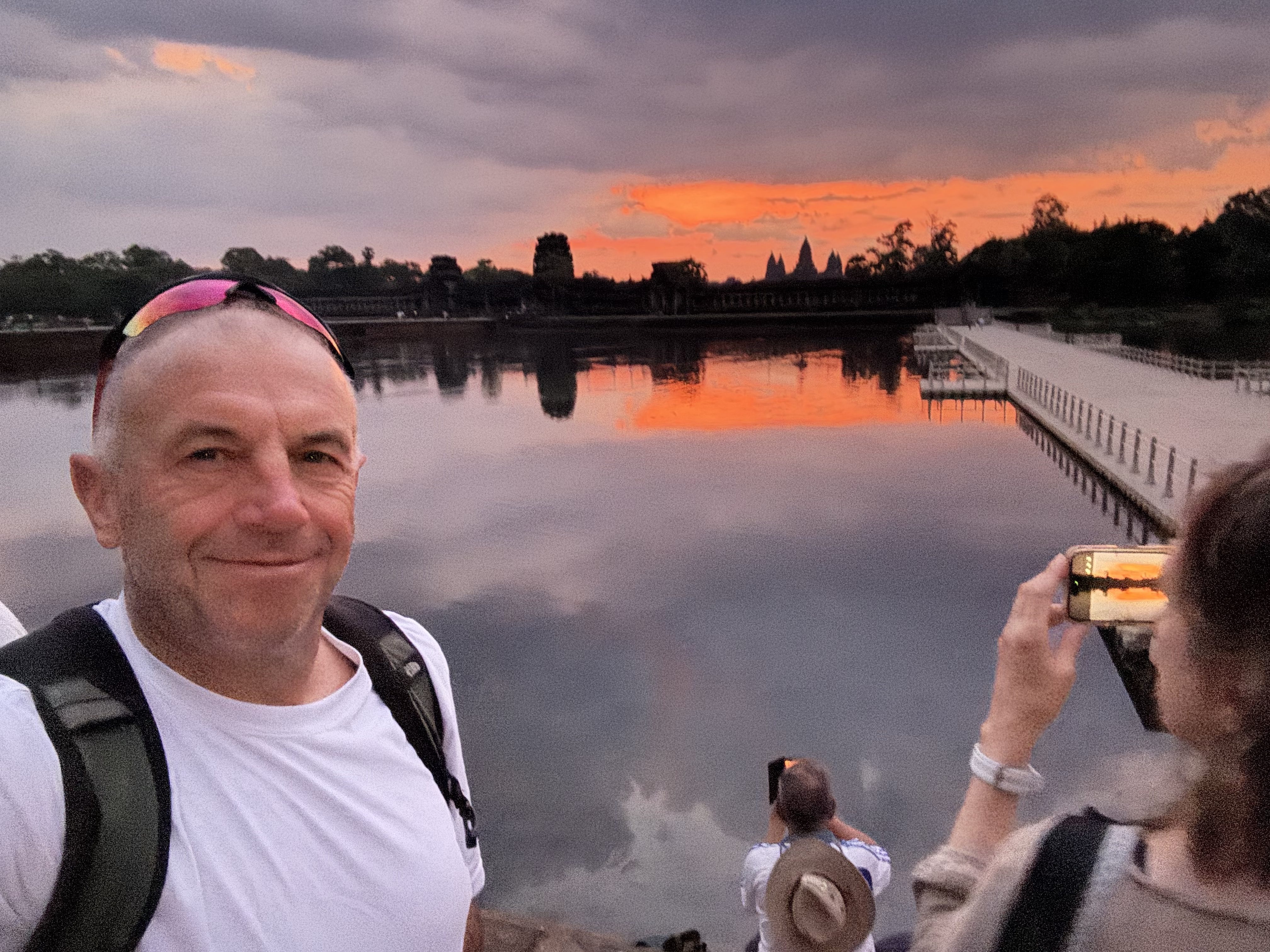

Most people arrive in Cambodia planning a visit to one of the most famous temples in the world, namely Anker Wat. Located on the outskirts of Siem Reip, located on a site measuring 162.6 hectares (1.6 km2; 401.8 acres) within the ancient capital of Angkor, it was constructed between 1113 and 1150 CE during the reign of the Khmer king Suryavarman II as a Hindu temple dedicated to Vishnu.
When you plan your trip, you normally have a choice of watching the sunrise or sunset, and bearing in mind the searing heat, we opted for the sunrise trip before the heat kicks in, the downside of that is you have to get out of bed a 3.30am to get to the site in the dark. I spoke to people who did the sunset tour as well, and apparently the heat drop off.

The coach picked us up and we headed off in pitch darkness off ready to for the sunrise, and there was no time to spare because daybreak broke very quickly after our arrival. Sunrise was the big show of the day and as the light increased the temple became visible across the lake and the cameras were clicking from to get their money shot.

Sunrise was a particularly tranquil experience, sat on the lawn watching the brighten over the temple and the monks pottering around chatting to tourists. It was then that it sunk in that one of my all time bucket list items had been ticked off. The various types of Wonders of the World can be an anticlimax or much better than expected, Anker Wat was almost exactly what I expected, which I guess is a consequence of so much information online.

Once the photos were done it was time to do the tour of the temple, which was getting hotter by the minute as the sun came up. It is made up of various towers and inner chambers that have incredibly carvings in the stone walls that record stories of history.
The temple was originally discovered by the Portuguese in the 16th century, then it was forgotten about and rediscovered by the French in the 18th century, when it became overgrown again and restored in the 20th century, it is surprisingly similar to the Inca temples in Peru like Machu Picchu.

The other intriguing issue is that the temple looks truly ancient, but it is less than 1000 years old, the problem is that the stone is eroding through being weathered. It struck me that in another 500 years it will have lost even more shape and just be lumps of stone. A lot of the temples has modern buttress supports and scaffolding to make it safe for tourists.

Climbing to the top of the biggest tower really did bring the history and scales to life and an opportunity to just absorb the atmosphere, which was getting hotter and hotter so we were ready for a b it of aircon bus and the next trip.
To be honest, most of the other temples were smaller versions of the Anker Wat, so the other temples were interesting in their own right, once we had seen the main event if did feel that the other temples were a bit of an anticlimax, so when we arrived at the café for breakfast and coffee it was a welcome relief.

My enduring memory of this tour, apart from the Anker Wat temple, was undoubtedly the Frankenstein type trees that have taken over the temples. These trees had grown up over hundreds of years and managed to creep their roots through the buildings to the point where the temples seemed to be dependent on these the huge roots to maintain their stability.
We did also see the odd monkey running around, but the power of nature through these trees, to exist within, around and over the buildings apparently existing outside of soil. Looking at the photos, they are still amazing.

When we had completed our tour of the temples it was some relief, as the heat was intense and there is only so many temples that you can walk through before boredom starts to creep in, however good the guide is and by midday it felt like we had been up all day, which of course we had.
The hotel pool beckoned and an afternoon trying out the monster cocktails became our mission for the rest of the day, before, heading to Pub Street for dinner again that evening.
