
My first near experience of dicing with death
Over my lifetime I have had many close encounters with disasters that could have ended much worse than they did. Most normal people don’t get themselves into these situations in the way that I seem to. This story is about the first of those close encounters and includes a bit of history about a very unique school I was privileged to attend.
Born and bred in Plymouth, I grew up loving the sea and still do. My dad was a shipwright in the dockyard and worked on boats all his life. Even though he was an accomplished student at school he wasn’t interested in following my grandad into the city council treasury, he wanted to work on boats and by the time he was 16 he had built his own canoe that he used for fishing.
A different era
This story is from an era where education was bigger than just books, and value wasn’t simply based on whether the school talked you into going to university, so some readers may find the fact that a school had its own sailing club is a bit odd. But then again, my school was a bit unusual, it was called Widey Technical Secondary School, this was an experiment from the early 1960s when educational visionaries recognised that not all bright kids were destined for jobs in banks.

The school focused on given bright kids who had passed their 11 plus a route to develop craft and engineering skills, not just academic skills. Consequently, the school had a fully equipped metalwork lab with lathes and lethal equipment nobody would dream of putting near kids (or most adults) nowadays. It also had a woodwork lab and by the time he was 15, my mate Paddy McDermott had built a boat for his CSE project and happily rowed it down the Tamar River with his mates.
In hindsight, this was all genius, because the major employer in the city was the Royal Naval dockyard and it enjoyed the benefits of a grammar level school churning out pupils ready to go into the dockyard as high performing apprentices in engineering. If only education and industry were as joined up now.
Unfortunately, I wasn’t one of the school successes. I didn’t seem to have much in the way of talents for woodwork or metalwork. The first project in woodwork was to make a dovetail joint which never seemed to fit properly and went on for months, and metalwork seemed to involve hours of filing which was very boring.

It wasn’t helped by my old man taking the mickey out of everything (he was a very good craftsman) I created and was assertive that I should never go into the dockyard. Generally, and unlike any of the other boys, I lost interest in these craft topics and by the time options selection came along I chose History and French.
Widey School Sailing Club
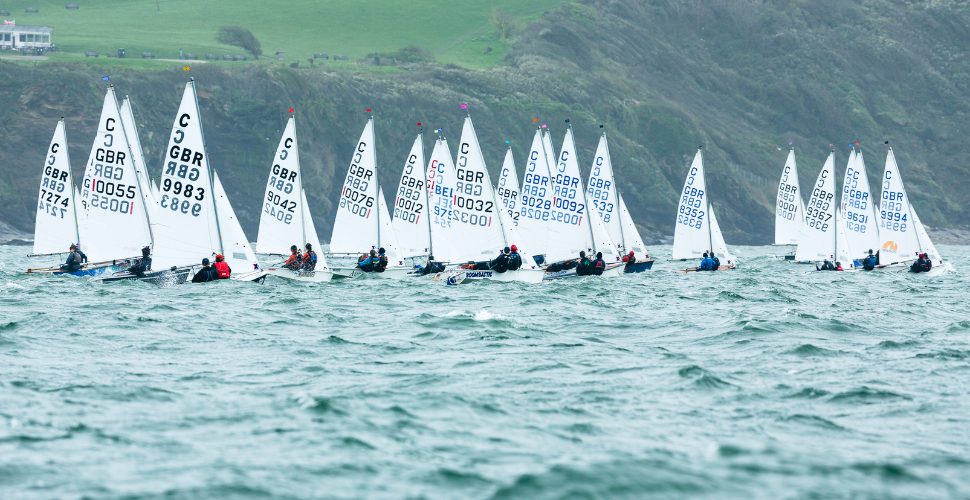
However, I still loved the sea and was very excited to be able to join the Sailing Club when I was old enough (there was a minimum age, 13 I think). The school had a little flotilla of boats for us to learn on. So, at the start of the summer, we all had to head to the Barbican and do our share of sanding and rubbing down to get the boats ready for the summer season, all under the watchful eye of the teachers, Max Wall and Paddy Padfield, we had 4 different types of boats.
- A GP14, this is the big boat with 3 people, a helm and 2 crew and normally had a teacher in charge
- A Mirror, this was much more modern than the others but only 2 people, I was never one of them.
- Cadets, a little research has unearthed that these are designed as training boats for youths, and we seemed to have a few of these.
- Safety boat with an outboard motor that pottered around following the flotilla rescuing people.
3 times a week we would look forward to going sailing, Tuesday and Thursday evenings and Saturday morning. One of the first things I learned was that we only went out when the wind was below force 4 as a safety precaution, I also learned that force 4 winds cause the tops of the trees to move. Every sailing day I’d be checking the tops of trees as we moved between classrooms keeping my fingers crossed, we’d be going out that night, but it often ended in disappointment. At the end of the day Plymouth is a windy city on the ocean, and I was amazed how many days were lost from high winds.

It’s fair to say that I didn’t turn out to be a brilliant sailor. Maybe it was lack of attention to detail or in fact attention to anything I was told, the boats were a bit uncomfortable and when I did go out in a Cadet they seemed to have a habit of capsizing for some reason, so more and more time was spent in the GP14 with the teachers or in the safety boat. It was almost as if the capsizing was my fault and I couldn’t be trusted.
The safety boat could be more fun as my love of the sea had got me into fishing, if Paddy was driving, I could take my fishing gear and a hand line and drop the lure out of the boat and do something useful with my time as we followed the flotilla around Plymouth Sound. Max didn’t approve of the fishing from the school safety boat so that curtailed my activities on occasions.
Widey Techn annual sailing day, 1974
Then came the annual Widey Sailing School Day out. We all congregated at the club on the Barbican at 9am with our packed lunches, warm cloths and looked forward to our freeby day off school. The weather didn’t look good, grey skies and spitting with rain, it seemed a bit windy to me but off we went anyway. Circumnavigating Plymouth Sound took most of the morning, backwards and forwards trying to get to Cawsand Bay, then more backwards and forwards as we tried to get out of it again.
Unfortunately, I was in the larger GP14 again under the watchful eye of Max rather than the Safety Boat, as I’m sure the fishing would have been good but instead, I spent the morning banging my knees and toes on the keel board thingy in the dingy.

Eventually, we pulled into a little cove on Penlee Point and onto the beach. I knew it well as we often pulled in there in my dad’s boat, I used to be allowed to row around in his tender, attached by a rope because I couldn’t be trusted, but at least I was afloat and unsupervised. Even though the beach was sheltered, outside the cove we were a good mile outside the protection of the Plymouth Breakwater, out in the English Channel.
As lads we messed around on the beach, ate our lunch and did most of the things we were told not to. Eventually the teachers couldn’t take anymore and decided it was time to go. As the boat allocations for the trip back were being made, I was amazed to be allocated to one of the little Cadets rather than the Safety Boat.
Dicing with death
That meant I had to concentrate, and as we pulled away from the beach, I got a lecture from the helm, I bloke called Robins who was a couple of years older, about doing what I was told. We could see the sea beyond the cove and the waves were now bigger as the swell had picked up in the channel. As normal I was in a scruffy mess, my lifejacket was untied and the rope was floating around near my feet and getting in the way. So for my own convenience rather than any thoughts of safety, I tied it around my waist and was ready for action. We were the first boat out of the cove, so it was very exciting.

As the little dingy pulled out we needed to tack quickly and run with the swell. In a swift and totally unpractised manoeuvre, we swung into action. As we hit the swell, “Ready about” was the shout and before I knew it there were sails and bodies flying everywhere and we new it we were in the freezing cold sea. Robins gave me daggers as we tumbled over the side, I don’t know why as it was his fault.
I felt myself come to the surface but for some reason couldn’t find any air, after a bit of panicking and fighting for air, I realised I was under the mainsail and swam out from underneath to find fresh air and a deep green/grey sea everywhere.
Initially, being wet and cold, I just wanted the safety of being back in the boat. I started to swim towards the boat, but smart-ass Robins got there first and clambered in. Unbelievably, with his weight changing the balance of the boat, it righted itself and the wind caught the sail and off he went, admittedly largely out of control but putting an alarming gap between me and salvation.
I remember those minutes in the water as if it was yesterday, I guess that is what shock does to your mind. There was no one around, the other boats were still coming out of the cove, so I was totally alone. Off Penlee Point the swell was bigger as it came around the headland, I was looking around at the swell lifting and dropping me back down in what felt like huge valleys of water., with white crests on the top of the waves slapping me in the face.

I remember thinking, “Thank God I did my lifejacket up”, because if I hadn’t, I’d probably have slipped through it and gone down under with the weight of a woolly jumper and other cloths. I then noticed my shoe bobbing along on the next wave and thinking I need to rescue it, or my old man would give me a battering so swam off to save my shoe.
In the distance, our dingy capsized again, which was excellent news for me, and I started to swim for the boat again, it was a couple hundred yards away by now, but I had to do something. Then the GP14 appeared with Max in charge, as it sailed past surfing down one of the waves he shouted, “Are you OK”, probably one of the daftest questions ever, of course I wasn’t OK, I was about to drown. “Yes, I’m fine, sir” I shouted back, so he sailed off and I was left bobbing around on my own again, trying to spot my shoes.
My saviour
Finally my saviour appeared over the crests of the waves and surfed past me in the form of the Safety Boat with Paddy at the helm. As with the GP14 he did a first pass, surfing down the face of one of the waves, he shouted “What are you doing in there”, the sort of question a teacher asks a pupil I guess, so I responded “Fishing, what do you think”.

He then went around and skilfully came alongside me, using the boat to protect me from the waves and was about to dragged me onboard when I spotted my shoe, so I wriggled clear and swam to get the shoe as I couldn’t leave it behind. I swam back and was then heaved out of the sea by the crew of the safety boat. I was dripping wet hugely relieved that I wasn’t dead, but a lot less enthusiastic about sailing than I had been.
We then went over and rescued Robins and secured his dingy to the rescue boat before hatching the plan to get us home. Annoyingly, that plan involved me getting back in the Cadet with Robins and sailing it back to the Barbican. I think it was on the basis of kill or cure, and it would help us get over it any fears that might have developed.
It is fair to say that the atmosphere between Robins and me was a bit frosty, and we didn’t talk much on the way back, so some reason he seemed to blame me for his incompetence, but someone has to be blamed, I guess.
When we got ashore, I dried off and was on the bus home to tell my mum as soon as I could. I honestly don’t remember going dingy sailing again until I joined the BBC Sailing Club on the Thames 15 years later, but that was more to do with a bar and BBQs than a desire to be a sailor.
That night, and for many nights later I relived that experience in the water. I still do now, which is why I’m writing this blog as the memory is so vivid. I still have nightmare moments that focus in on “what would have happened if I hadn’t done up that lifejacket to get rid of the strap”.
I’ll be forever grateful to Paddy, the teacher for rescuing me and the sight of the Safety Boat surfing along the tops of the waves actually gave me hope, as I thought I was done for.
The process of writing this blog has left me with two thoughts.
- What a brilliant education idea Technical Grammar schools were. They were totally designed to create employable young people ready to go into engineering, we have absolutely nothing like that anymore.
- Shock, if this incident could be so embedded in my head, what must it be like for people who have much more severe experiences, whether it’s the traumatic things we see on the TV or the experiences of the armed forces and rescue services that are happening all the time. Maybe if there are lots of them, they overwrite each other or maybe it was because I was young.
This wasn’t to be my last close encounter with disaster, but it was my first and I’ve never forgotten it.