
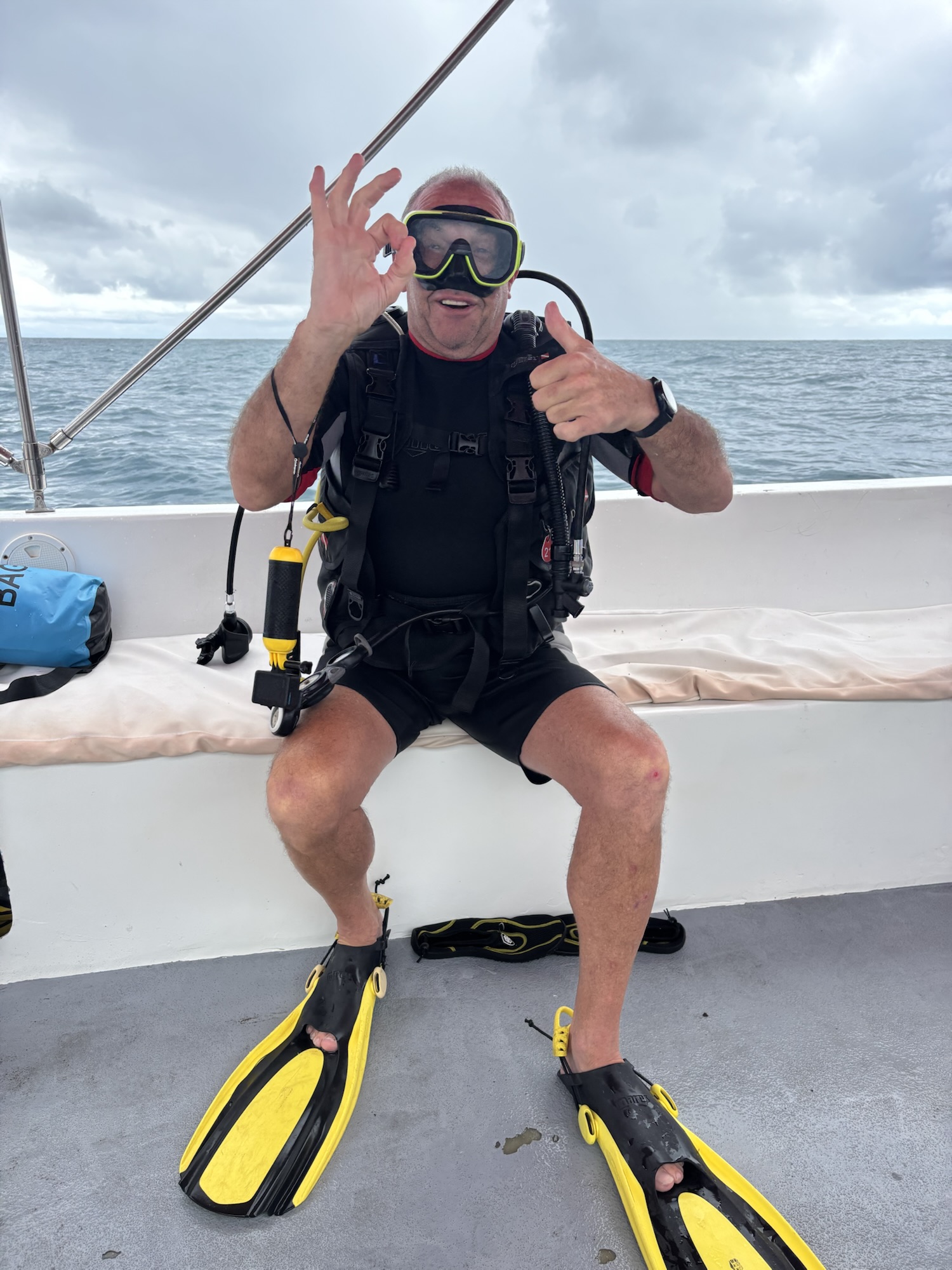

Our final adventure for this trip was scuba diving. There are a few dive places in Costa Rica and the Canos Island off Uvita is one of them. It has the added benefit of a boat trip across the straights that are used by the migrating humpback whales with Costa Rica Dive
I was looking forward to leisurely trip out to the island a mile or two off the beach, so the powerboat ride came as a bit of a surprise !
I first tried Scuba diving on the Great Barrier Reef off Cairns back in 1997. It was such wonderful experience I came to the decision that it I would never dive anywhere better than there, especially in the cold waters off the UK, so I parked my interest in Scuba diving and was happy with the memories. It is also a very expensive sport, so when travelling with kids and on a budget, it was never high on the priority list so we would always go snorkelling anyway.
That changed when we visited Zanzibar in 2024, despite its beauty and a great hotel, I still got bored after a few days, so I invested in a Scuba introduction course and 4 escorted dives. It was a fabulous experience, heading out to deserted atolls and reefs in an old fishing boat, and then diving down into the coral and swimming with the fish rather than watching from the surface. I was hooked and committed to doing the PADI open water certificate as my next challenge.

Surprisingly it went completely out of my mind until I got to Uvita and saw the dive trips advertised. As with many things in Costa Rica it is priced for the American market and at $299 was an expensive day out, but I decided to give it a go. I was anticipating another pleasant day out, plenty of sunshine, a few whales and lots of fish on the coral at Canos Island, about an hour out to sea.
Things started to go wrong back in our room; I dug out the GoPro to take diving and discovered my battery charger was broken and I didn’t have the cable for the camera itself so wouldn’t be able to use it. Which left me with my little Go Pro camera which only works at depths of up to 10m, and we would be going down to 15m so it could be a problem. You will be surprised to know that I thought, “Pah what is the worst that can happen” and decided to chance it.
First surprise was to wake up at 5am for the trip to find lashing rain and howling wind. Not quite what I was bopping for, but this wasn’t enough to deter the dive trip operators, so we marched to the beach from the dive centre, for boarding onto one of the high powered speed boats bucking around in the surf. Loading the boats wasn’t straightforward either, we had two groups, helpfully named Boat 1 and Boat 2, by the time we got to the beach we had become the names of the boats, so people in Boat 2 had to get into the boat called Mako Shark. I had missed this bit of nuance somewhere as it had been announced in Spanish, so we all assembled on the beach ready for something to happen. One group headed towards the surf, and one didn’t move, feeling a lost soul, I decided to follow the group to the beach as the leader was with that group.
We all marched towards the surf behind the rather disorganised leader, but when we got there, he then noticed that only one group had followed him to the waters edge, the other group were still 300m away stood by the trees. There was then a lot of waving and shouting in the wind, before the aforesaid leader had to run all the way back up the beach to collect to explain to the second group they needed to follow him. While he was away, I asked another one of the dive blokes what was going and solved the problem of which boat I was in, I was in the Mako Shark.

Next surprise was on the boat, which was evidently a high speed launch. We all put on our life jackets, were warned not to put our hands over the side, then the skipper hit the throttle and we accelerating to high speed, like some sort of drug smugglers escaping from the feds.

As you can see, Canos island is not exactly off the coast of Uvita, it is about 50km south and well out to sea, so no either def we were in a hurry.
High speed boat transfer
Out we went through the choppy seas with lots of airborne moments reminiscent of power boat racers. We quickly sped past the island I thought we were going to and headed out into the Pacific Ocean, where we were lashed by rain and wind. Not only that, but we also had our dentures loosened by the high speed crashing of the hull as it bounced off the swell, if there were any whales around, they would have dived out of our way. This was not the relaxing experience I had in Zanzibar for sure and my Garmin watch was tracking our speed at 40kph.
After about 45 minutes we saw a distant island and 75 minutes the skipper throttled back and soon we were ready to dive. After going through the laborious process of putting all the gear on, and armed with my GoPro camera, I flipped back over the side of the boat ready to explore the deep.

First dive into the depths
The next surprise was in the water. Once I organised myself and looked around, I noticed there was no fish or reef but there was a buoy with a long rope. The purpose of this rope was to pull ourselves down to the depths where the reef and the fish was lurking, so down I went pulling myself down by the rope, with the other divers. Suddenly my GoPro camera came to life and started filming, which I thought was very clever so I waved it around filming anything that moved, but then a big red sign popped up to say I was too deep and it was warning me it would not work, and promptly switched itself off – great.
The first dive was pretty good, and I achieved a big ambition, to see a shark in the wild. In fact, I saw 2, one swam past giving us a shifty look, and the other shark was having a kip on the ocean floor. The other big sighting on the first dive was the giant turtles, these really are magical creatures that look like rocks until they move. This is also their mating season and we were giving a grandstand view of a couple of giant turtles fornicating in the deep, it didn’t last long as the male fell off, but they seemed to have had a good time and the male set off in hot pursuit of his mate with enthusiasm.
Second dive on to the reef
Dives only last for 45 minutes and as our oxygen started to run low, we headed back to the boat for the obligatory rest and to clear our lungs before we can dive again. We all loaded back on the boat clumsily in our scuba gear and chatted about what we had seen, my group had been lucky compared to the other group which hadn’t seemed to see anything, but that is the way of nature.
There are many lessons to be learned about nature, and a new one raised its head. On the boat trip out we had been bumped around a lot which stimulated the desire to pee but didn’t really have an opportunity, then we had gone down into the depths in our wetsuits where our bodies were under pressure, and now we all needed a pee, quite desperately in some cases.
An unexpected problem
The skipper spotted the problem and said that if we needed a pee, take the wetsuit off (apparently, they smell) and jump over the side to do our business. Within seconds the boat was covered in the discarded wetsuits, and the sea was full of people trying to have a pee but failing. We then learned a bit about biology, we normally have the assistance of gravity when we pee, but in the sea it isn’t there as we are suspended, added to that our core muscles are busy stopping us drowning, so it is like trying to pee whilst doing a sit up in a gravity free zone – basically it is a very difficult thing to achieve to any level of satisfaction so we continued only marginally relieved, so to speak.

After our contortions, we reboarded the boat, kitted up and were back in the water for our second dive. Same process, grab the rope and down we went on a different bit of the reef. The difference was that on this dive it was our turn not to see anything. We were initially greeted by a shoal of fish that looked like zebras, so it started well, but didn’t get any better as we swam around for 45 minutes in the equivalent of subterranean desert, there were amusing moments as various members of our group floated away and had to be rescued by the guide, but to be honest I was getting a bit bored and spent more time focused on trying to have another pee, so was glad to come up in the end.
Back on the boat, the other group had lots of stories about their sightings and generally started getting on my nerves. The truth of the matter was that we had a disappointing day with water based nature, possibly due to the rough weather that had sent the fish off to somewhere else. We then had a very nice lunch on the boat, inevitably a burrito and fruit, but it was much appreciated. I noted that people weren’t drinking much, which might have been on account of most of them still needing a pee.
Before we knew it we were crashing our way back along the coast through raging storms, no sign of whales, and the dramatic arrival at the beach, the skipper didn’t even break from our 40kph before he did the waterborne equivalent of a handbrake turn when we were about 50m from the beach, in a spellbinding manoeuvre that dumped us back on dry land before we knew it.
Lessons from the trip
So, I learned a few lessons from this:

- Check how far out to see the reef is, because an hour in a chugging fishing boat is lot different to doing it in a power boat.
- How deep is the reef, because the bright lovely coral I saw as a snorkeller is only a few metres deep, when you get to 10m the sun is missing to the coral is going to be dull, if it exists at all.
- Check that you have the all the GoPro cables before you leave home and don’t break the ones you have.
- Don’t wear your Garmin watch when diving, despite it being guaranteed to 50m, something happened on the dive at 12m, and it is now written off.
I have now promised myself that I will be going on an adventure to get my Open Water certificate, this is the same promise I made to myself last year, but I really mean it this time.


