What to find in the town and surcharges for European
We managed to get to Bariloche with surprisingly little drama. FlyBondi had a good day and were only 90 minutes late. Bariloche is the tourist capital of northern Patagonia, which is known for its massive array of lakes surrounded by mountains.
So, our expectations were for lots of water, and we weren’t disappointed when we found our hotel had a fantastic view of the biggest lake, Lago Nahuel Huapi. We stayed at a brand new Radisson Blu, which promised much but seemed to still be in the shake down period with lots of issues and things not working which were a bit disappointing, but hey, it had a great view.
Bariloche is a major ski centre in the winter with pistes on the mountains behind it in Cerro Catedral. The high street is full of bars and restaurants with strong Spanish and Alpine influences, however, just like most skiing resorts, if you aren’t skiing there isn’t much else to do. There are a few boat trips but with freezing cold water there aren’t many water sports going on.
A thing we had not seen before was dual pricing of tours. Basically, if the tour included an English speaking guide the costs were significantly more than for a Spanish speaking guide. In the case of Circuito Chico the Spanish tour cost £13, and the English tour cost £30, for the Tronodor Glacier the price difference was £45 for Spanish and £80 for English.
We gave it some thought and decided that we would be quite happy to forgo the tour commentary as we were going for the scenery anyway, so we went with the cheaper option with differing experiences!
On the first tour, it transpired that only 3 people spoke Spanish, so the guide received some adhoc English lessons, on the second tour nobody spoke English and on the third tour we had a personal commentary from an English speaking guide, so all in all it was money well saved.
The locals have a bit taste for chocolate. Every other street seemed to have some form of chocolate shop going on but the ultimate was the chocolate supermarket, the irony of this being that iin a 3 story department store, the ground floor was dedicated to chocolate and the other two floors were a gym.
Not only did it have a department store, it also had a museum, who on earth cares about the history of chocolate, surely you just buy it, eat it, regret it, forget it. Not in Bariloche, they just love chocolate.
There appears to be a bit of a sinister past to the town and many of the Nazis headed here after the second world war, there is even a walking tour dedicated to the memory, which in my view shoul be forgotten but that is life.
There is also a nice civic square. It is build in a European style and does not appear to be very old, but it is very pleasant and there lots of shops around there if the weather is wet.
So all in all, Bariloche is a dull place in November unless you like chocolate, but the locals are very friendly and I definately got the impression it would be a lot more fun in the ski season when all the bars are open.
A whistle stop tour of a surprisingly attractive city
Well technically it wasn’t a day in Buenos Aries, it was only half a day because the world’s most useless airline, Fly Bondi. They managed to cancel both flights, so we arrived in Buenos Aries 24 hours later than planned, and then the flight that did leave was 8 hours late, so we lost a big chunk of the day allocated for our stop over.
However, adaptable as ever, we still managed to make the most of it, had a good tour and stayed at a great hotel. Any hotel that isn’t a chain or wants to overcharge now calls itself a boutique hotel, but Fierro hotel was an absolute cracker. From arriving at reception at midnight and finding out breakfast is served until 3pm to entering the room to find a fridge with champagne and a wine cooler, it really was the real deal.
Our flight to the Bariloche was scheduled to leave at 1630, but it was Fly Bondi, so time and day don’t mean much, but we were on a tight schedule. We were up early for the city tour, we had booked with “Tours Buenos Aires” which didn’t start too great. The taxi picked us up at 8.45am and we were still sat in the cab an hour later. It wasn’t clear if this was caused by the infamous Buenos Aries traffic or he just got lost, but anyway it wasn’t good.
We finally met up with the coach tour, where we met Rosa, a lovely lady tour guide who seemed to have no grasp of time, which probably didn’t matter to the rest of our fellow tourists but was of critical importance to us, so the tour ended with us jumping off the bus and getting an Uber it ran so late.
We have more days planned in the schedule for Buenos Aries, so this was a great chance to get an initial feel for the place. After Rio, we weren’t too optimistic about the city, but Buenos Aries is a surprisingly attractive city. Unlike Rio, it has embraced its European roots and the buildings are stylish, in fact, you could be in any major European capital city, including the traffic chaos. Maybe it is the effect of being a nations capital that leads to the building having more status.
The tour headed to the Boca area of the city. This is the oldest part of the city where the trading ships from around the world arrived, it is also the home of the Argentine Tango culture with a rich and colourful history.
Republic of Boca
Within the “Republic of Boca” is the Caminito, this is a complex of streets that are dedicated to all things wonderful about Argentina. The houses are all brightly coloured and have murals of famous Tango artists or figures of famous Argentinians like Maradona and Messi looking down from balconies into the streets.
Argentina is famous for football, rugby and polo, so it came as a surprise that this is not it’s national sport, it is a game called Pato, which involves horsemen throwing a duck between themselves. To prevent cruelty to ducks, they now use a ball that has handles as is thrown instead, not many people know this!
The world famous football team Boca Juniors stadium is right in the middle of this area and provides a colourful backdrop to local streets, and with all the bars, one could imagine match days being quite lively, in this area.
Palermo
Even the dogs where football kits
We then moved on for a tour of the city, many of the government and main buildings were designed by the French and the Italians and together they do make an attractive place to be.
There are numerous parks that give the feeling of spaces as your travel around the city, but in practice they seem to provide opportunity for racing circuits for the cars. The area of Palermo is one of the most attractive suburbs with lots of greenery.
Presidential Palace
There is a central square with the president’s palace and the balcony made famous by Eva Peron. It impossible to escape the legacy of Eva and her impact on the country, it is deeply embedded in folklore similar to Lady Diane in the UK and Marilyn Monroe in the US.
So, it was a brief visit, but it has given us lots of ideas for when we come back. We had planned to do the day trip to Montevideo in Uruguay. However, we discovered the day trip to Montevideo is 5 hours each way so isn’t really a day trip, so that is now off the itinerary.
Time to head to Patagonia for the next phase of our adventure.
If you are going to come to South America, then the Iguazu Falls will be at the top of your “must do” list.
We went a long way out of our way get here and it didn’t disappoint.
There are lots of variations on the way to see the falls. They falls themselves are mainly on the Argentinian side, so you get an up close experience as the boardwalks are built over the actual falls. On the other hand, the view from the Brazilian side is across from the falls, so you get to see the whole panoramic view.
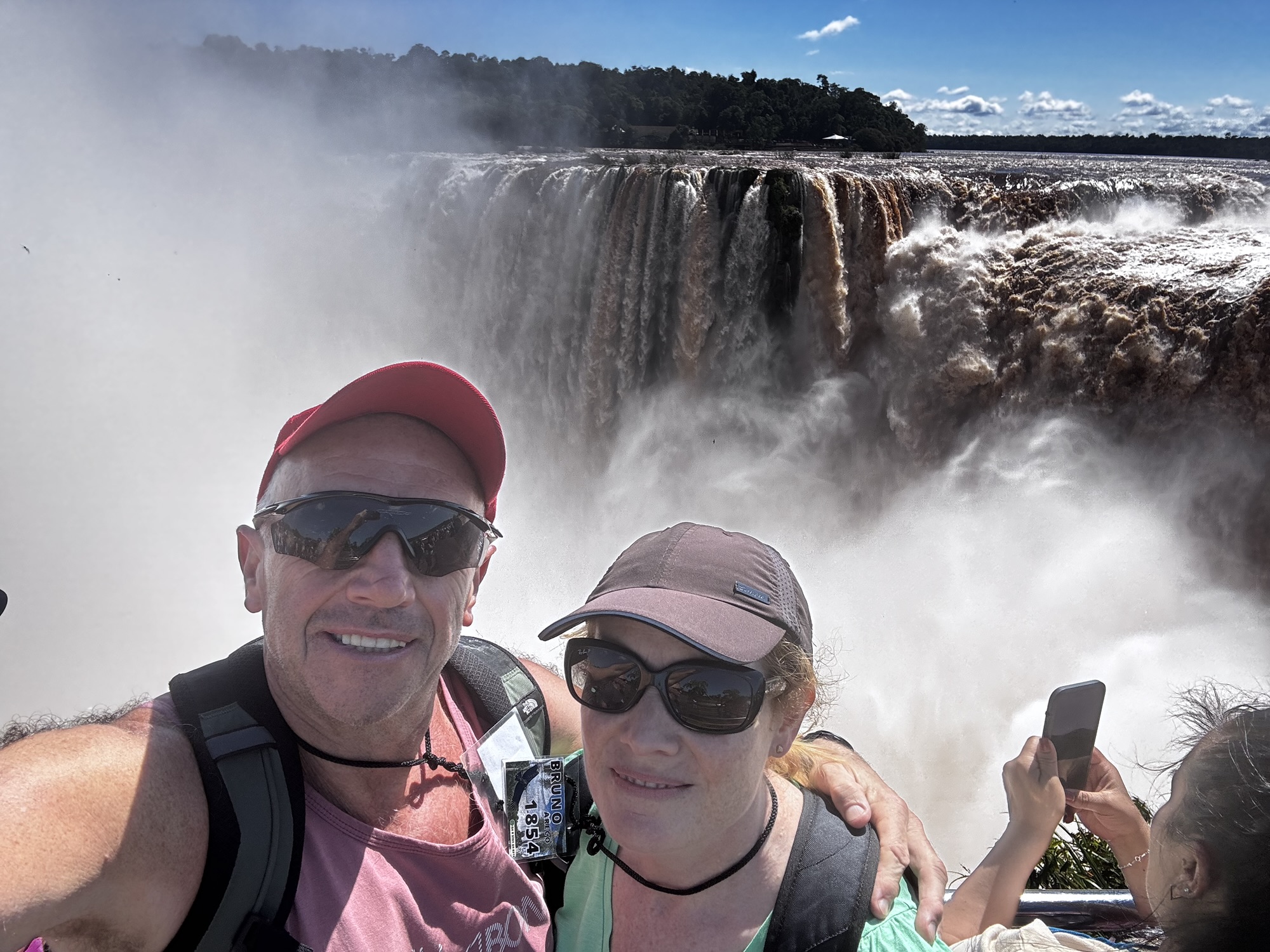
So having looked at the various options we decided to do a whole day trip on the Argentinian side, so you get up close to the falls. We used Tripadvisor and chose a company called Say Hueque Travel and we had a great guide called Bruno, very friendly, spoke great English and really helped make it a fabulous day.
The package we chose covered the three different trails in the Argentinian national park, and the 4×4 truck ride and the power boat ride under the falls themselves. To be honest the 4×4 truck ride wasn’t up to much as it was just a lorry driving through a jungle road btu the rest of it was great.
Our trip was in November, and it transpired that there had been exceptionally heavy rain along the 1000km Iguazu River, so the river was in very high flood, which made the falls exceptionally spectacular.
The jungle train to Devils Throat
Arrival at the park has the normal ceremonies with ticket collection. I hadn’t realised that the park entrance wasn’t included (note for you budget) so had to pay another £20 each to get into the park. This seemed a lot at the time but when you see the infrastructure they have installed it was worth it.
The day starts with the train ride to the far end of the park, and a place called the Devils Throat station. The train is about 20 minutes and then there is a 2km walk along a walkway out to the edge of the falls, this is slow going if you have a big group of slow coaches ahead of you!
The bridges stretch right out to the very edge of the most spectacular part of the falls and I couldn’t but marvel at the human ingenuity to get the walkway into such a dangerous place. I found out later that there is a damn that can slow the flow and at different times of the year. That being said, it is still and incredible structure that is built right up to the edge of the cliff.
It struck me, for some reason, that if you wanted to commit suicide this would be a great place to do it, because there would be absolutely no second chances for a jumper from this boardwalk!
Words cannot really describe the noise and sensory intensity of this part of the Devils Throat. There are better views from the other lookouts but watching the plumes of water vapour rising in clouds from below was a particularly mystical experience.
Once we could take no more water, we trekked back along the bridges to hope on the train back to a bit of civilisation and the middle station on the Jungle Railway which drops us at the Upper Trail and the restaurant area.
Iguazu Falls Upper Trail
The Upper Trail was empty when we assembled for instructions from Bruno, by the time we set off a huge group of Japanese tourists had clogged up the trail, so we had a very slow walk surrounded by idiots with every type of camera, every type of gismo and a tendency to stand in the way wherever there was a good shot.
The two best lookout points along the way were Salto Bosseti where there were spectacular views along the top of the falls towards Salto San Martin which is the end of the trail.
We battled for dominance with the Japanese along the trail, but their numbers were overwhelming and their sense of urgency non-existent, but luckily they are short and I am tall so I was able to get plenty of memories.
One spectacular view from Salto Bossetti is down into the ravine and the power boats that were coming up the river and driving into the falls themselves, which gave us a pretty good idea of what our boat trip was likely to involve.
The main wildlife were the racoon type scrounging creatures. I sat down for a breather in the heat and before I knew it there was a racoon thingy climbing onto my ruck sack, it had clearly sniffed out my Double Decker bar, so I gave it short shrift but not enough to make it angry, as they looked particularly nasty.
Iguazu Falls lower trail.
It probably took 90 minutes to complete the Upper Trail and then it was time for lunch. I have to admit, the food selection was good, with 3 different cafes offering lots of choice so we went for the buffet.
After lunch we had the option of sleeping (which the Mexican opted for) or doing the lower trail, which the Brits, Canadians and Americans chose. It was a very different view as we trekked below many of the outflows, so had water cascading all around us but only got drenched once.
The trail is cut into the hill side and gave a completely different perspective on the various falls and just how tough the terrain is in this region.
After another 2.5km walk we were back at the food halls and searching for the sleeping Mexicans who were having a lovely siesta under a tree. At the point it was time to join the queue for the jungle expedition and the boat ride.
Jungle and water adventures.
Having seen the boats from Salto Bossetti there was no danger we were not going to get wet. Some determined souls found capes and waterproofs, but it did feel like it was going to be a bit futile and so it transpired.
First though, we had the truck ride through the jungle, and our guide seemed to be some form of jungle high priestess, as she clearly worshipped the vegetation. On a number of occasions, the truck stopped just so that we could listen to the silence in the jungle.
The jungle itself was a bit light on creatures, but we did see a few toucans and a couple of giant lizards wandering around without a care in the world. The most amazing sight was the butterflies, they were huge and plentiful and lots of different colour, they are almost impossible to photograph unless they land on someone, but I did get a nice video as we boarded the power boat.
I was first on the boat, grabbed the front seat, got my GoPro ready for the journey and sat back. There isn’t really much to say about the powerboat ride, other than it was very intense, lots of fun and hope you enjoy the videos, they tell the story better than words.
We had 3 days to explore Rio. There are many options that involve walking, jeeps or a variety of other forms of transport, but we also wanted to enjoy the beach life while we were there.
We considered the Flavella walking tour, but after some thought it didn’t seem right to be paying to stare at how poor people live, so we settled on a tour that did the major sites in one day.
We chose a tour with a company called City Rio Turismo via Tripadvisor as it had all the main sites included, but it wasn’t cheap, costing £80 each. It should be noted that the entry fees to Christ the Redeemer, Sugarloaf cable car, and a very large BBQ lunch were included in that price, so it was pretty good value.
Sugar loaf queue
One of the benefits of visiting the tourist hotspots in the rain is nobody else is there, so the legendary queues were missing, getting wet has its benefits. It was a long day, leaving at 8am and arriving back late in the afternoon, but we saw a lot of the city, despite the rain and fog, so here are the highlights.
This is a really imaginative attraction and a complex engineering feat. The original cable car went to the first of the outcrops at 220m above the sea, it was built by Swiss climbers back in 1912 as the rock is almost sheer so very difficult to climb. The second cable car extended up to 400m but crosses over the city to give a great view of the harbour and beaches. Obviously, the views from the top are much better so the middle level is now basically a transfer area with a café and a Heineken bar!
Argyle fan in Rio
When you get to the top there are walks around the ridge, but the scale of the concrete structure perched on the pinnacle is really amazing. The view across to Christ the Redeemer would have been spectacular but all we could see was thick cloud.
The main benefit of doing the cable car it to get a view of the vast Rio harbour which stretches into the distance inland. In many ways it is similar to Sydney and its spectacular harbour.
We were being thankful that we could see Copacabana when the rain and thick clouds arrived and we got soaked, so time to head down.
Because of the weather, our courier Lauren decided we would have an early lunch to see if it improved, however as we passed through the city suddenly the clouds parted, and we saw the statue for the first time. All the images are of a beautiful statue on a clear blue sky day, but not us, just a distant grey finger poking through grey clouds.
A sudden change of plan and we headed up the mountain towards the stature for the break in the weather. The logistics of building it must have been incredible, the minibus took us up the steep winding road to the reception area, where we swapped buses and headed for the summit excited at the prospect of visiting one of the most famous attractions in the world.
We climbed the stairs to the statue reception area and walked around it. It was a totally awe inspiring sight, the statue is as big as I expected. The face is amazingly tranquil as it stares north, presumably towards Rome or Europe.
Heavy rain at Christ the Redeemer
It wasn’t long before the rain came back big time and the clouds closed in and visibility disappeared again. However, we did get a glimpse of Ipanema beach through the clouds. The next day when the sun came out, we were able to see the stature from Ipanema beach as well, this was a great moment.
One regret from this trip was not riding the train up to the statue. The route looked spectacular through the jungle and with gradients steeper than I have seen anywhere else, so if I come back that will be on my list.
We had a long drive through the traffic to the stadium and a drive around the perimeter. As a football fan I was excited to see this legendary stadium, but it was disappointing. A massive sprawling concrete structure with walkways heading in various direction so there was very little to see. I am sure it is wonderful inside but as a visitor drive past it was a bit of a waste of time, they didn’t even have a stature of Pele!!
Next stop was the catholic cathedral, which I have to say was a real eyesore. One of the pug ugliest churches I have ever seen, it looked like a concrete wigwam stuck in the middle of the city. To be honest it improved when you stepped inside and the effect of the glass walls took effect but from the outside it was just plain ugly. It wasn’t clear whether it was a design flaw or intended, but it does not have bells or bell tower, maybe the concrete wasn’t strong enough to hold them. So, the ingenious builders built a separate bell tower for one bell, not surprised it hasn’t caught on as a design concept!
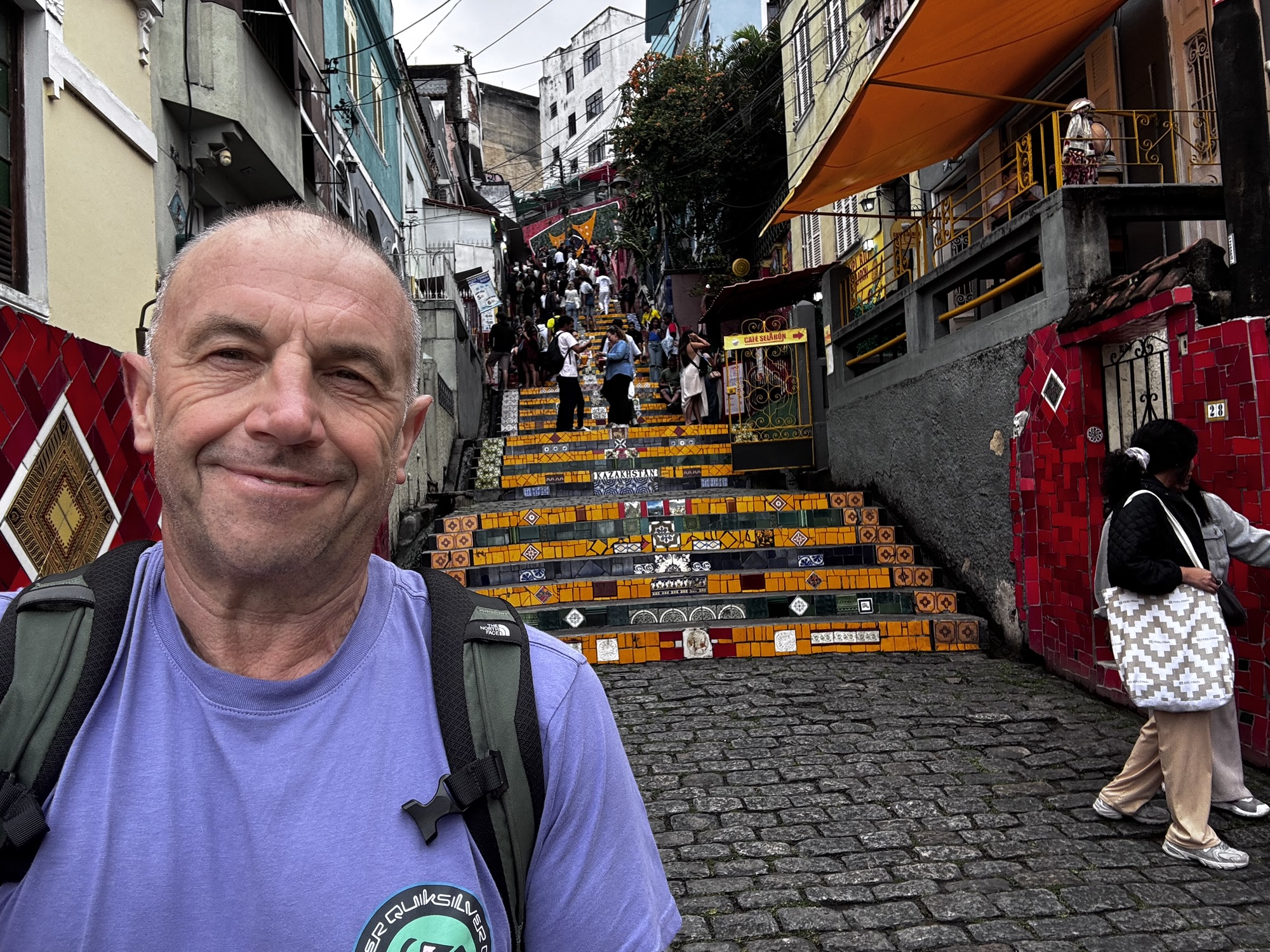
Last stop of the day was the famous Selaron Steps. Apparently, some chap decided to collect tiles from around Brazil and decorate the steps with them, which was a nice idea and has built a handy little tourist attraction.
Where there are tourists there are markets, so you have to battle your way through Brazil football shirts to get to the steps and then you have to take on the Instagramers doing their photo thing and wanting to take over the steps. There are 250 steps, they start steep and get steeper, so we battled our way to the top to get the tick in the box.
On the way up there are little bars and sound systems to keep you going, there is also a selection of art around the streets that makes for a colourful experience to end the day.
The trip ended up back at Copacabana Beach, and I headed straight to a bar for a recovery drink. Apart from the specific stop offs, we really got a feel for Rio, with its busy traffic and endless concrete high rise blocks, 17 million people have to live somewhere and get themselves around at the end of the day, but it’s not pretty.
So, thanks to Lauren for navigating the weather effectively, and at the end of it, I feel like I’ve seen the best of Rio.
We all have a view of what to expect in Rio, but is it really like that?
First stage of our South American adventure is a little stopover in Rio de Janeiro. It is a vast city, so the first challenge is where to stay.
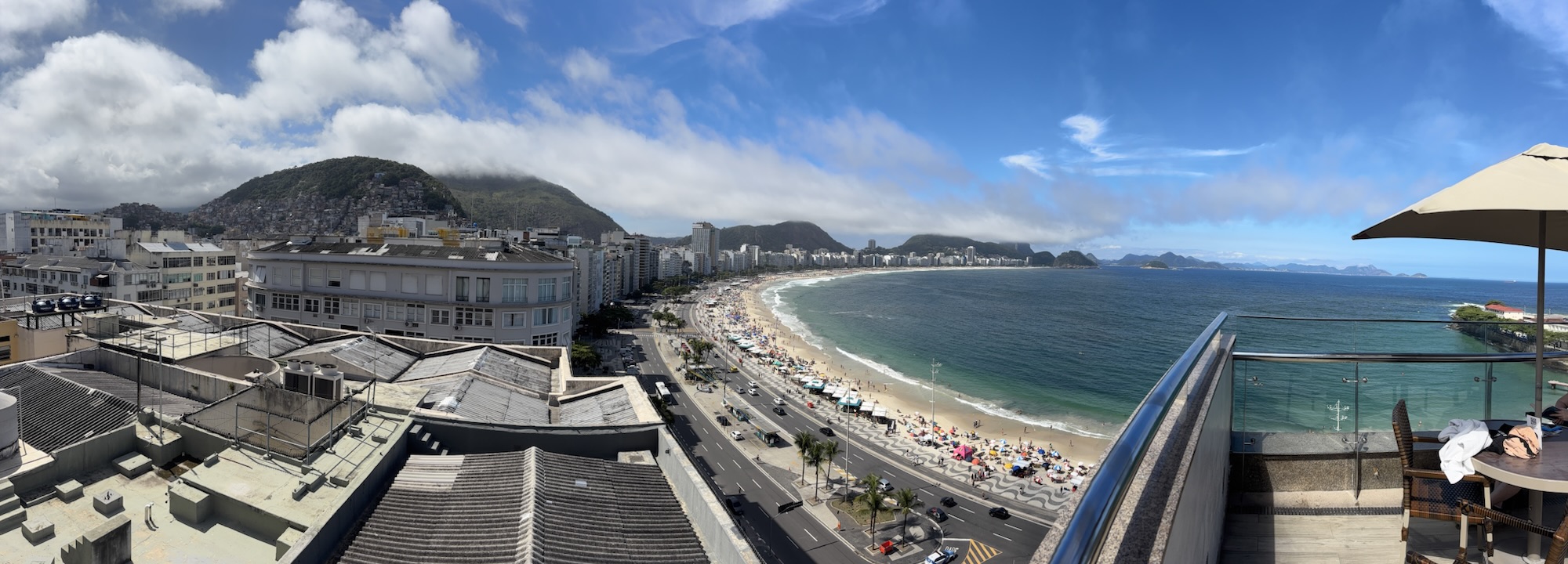
To be honest that one is easy thanks to Barry Manilow singing about the Copacabana Beach all those years ago, so we headed there, which is the main tourist zone, but also has a big contingent of locals at the weekend enjoying their city.
The famous beaches of Copacabana and Ipanema are right next door to each other, are both 4.5km long and only separated by a small headland. Ipanema is golden sand whilst on Copacabana there is white sugary sand and both make for great walks to enjoy the beach life.
There is something incredibly exciting about making it to these world famous beaches but in truth, they are similar to any Spanish costa, with high rise apartments on one side, and endless beach side cafes to sit and enjoy a coffee, beer or cocktail. They are famous for the beach football, volleyball and surfing and there is plenty of each, but the surfing is a bit overrated to be honest, I didn’t bother going in it was that average.
The city environment
Rio itself is not a beautiful city. It is set amongst steep, jungle covered mountains which give it a natural green beauty, but the human contribution has turned the valleys and plains into a concrete jungle of old concrete high rise buildings that have had no sympathy for the colonial history and generally overwhelm the older buildings. Probably the highlight of this is the modern Catholic cathedral, it would be hard to find an uglier building.
The massive natural harbour is one of the wonders of the world and as you move around the city there are numerous beaches in each of the suburbs. Having done a tour of the city, I can’t think of any reason why anyone would want to stay anywhere other than on one of the famous beaches, or near it if your budget is a bit tight. It is a very busy city, with traffic jams everywhere and I can’t imagine having much fun in the other suburbs.
The Weather
A big surprise was the weather, when we were doing our checks, it was consistently sunny and 30c. Our first day was overcast and turned into heavy rain, thunder and lightning, second day lots more rain and thick fog, third day we had clear blue sky and sunshine, so we have 4 seasons in 3 days, the only thing we didn’t get was snow. I guess there is a reason why the whole area is jungle, it gets lots of rain!
Luckily, we scheduled our city tour on the wettest day, but in hindsight this was probably a bit of luck, as we were able to enjoy the beaches when the sun was out.
Language
Having spent 2 weeks plugging away with Duolingo to learn some Spanish in preparation for Argentina, it was deeply disappointing to note that the Brazilians didn’t respond to my attempts at being friendly in Spanish. Now I do realise they speak Portuguese, but there are enough similarities to be civil.
I then realised that most Brazilians don’t speak anything but their own version of Portuguese, no Spanish at all (maybe on principle!), and they don’t speak English either, so the early exchanges in the beach bars and shops of the Copacabana were very hard work, which really surprised me bearing in mind it is such an attraction for visitors.
Global Cities
If I had to compare Rio with one city it would be Sydney, with the beautify harbour and beaches and a population that loves the outdoor life.
A few years ago, I concluded that there are some cities in the world that are very different to the rest of that country.
The first time I noticed it was on the US, where New York stands apart, Los Angeles was nothing like the rest of the US or New York, similar if you travel to Australia then Sydney is totally different to the rest of the country and London is the same.
The difference with London is that it is also the capital city, unlike the others. I put Rio into this category, as a global city, where people flock to experience that individual vibe.
In all those cities, you can stand and watch herds of people passing by and it is difficult to spot what race that country is. In Rio there is such diversity in the population that you couldn’t say “That is a Brazilian”.
The food
First impressions were pretty good from the beach front bars at Copacabana with lots of fish and steak with unusual sauces and tastes.
On the city tour we had a Brazilian BBQ which involves eating as much meat as you can. We were lucky enough to stumble out of a rain storm into a restaurant in Ipanema called Bodega Belmonte which was a really authentic dining experience and we had a great afternoon eating and avoiding the rain.
So, our tour of South America is up and running with a great start in Rio, one of my life ambitions achieved.