Tag: adventure

  • Exploring Vietnam – 3 surprises

    Exploring Vietnam – 3 surprises

    We are just back from our adventure in Vietnam, a truly wonderful experience and one that I will remember for the rest of my life. There are millions of words out there about all the things you can do on a trip to the country, and I will be adding to them over the coming weeks as I pull together the blogs about the places we visited.

    Vietnam is a country in the midst of a modernisation revolution, on the one hand it has a become a massive manufacturing sector that most of us know for sports shoe brands, it even has its own car industry. Whilst on the other hand when you venture out into the countryside the rural communities are subsistence farmers, living off their land and selling goods at local markets. So not only it is exciting and vibrant, but it is also a place of contradictions, between the claustrophobia of Hanoi to the peace and tranquility of the mountains.

    I thought I would start with 3 things that I did really expect when we were doing our planning, and hopefully these will really help you with your plans.

    Vietnamese money

    Their currency is an absolute nightmare, you can have a wallet full of paper money and not have enough to pay for a coffee, the notes come in lots of different denominations with the biggest being 500,000 dongs, and the smallest is on 500 dongs. Even worse, they all look quite similar, so it is possible to get into a horrible mess.

    What makes it a little more difficult is that for all modernisation in Vietnam, they haven’t really moved towards credit cards, which are rarely accepted, so you don’t have the simple alternative to just tap and go. It is very much a cash economy and they use a payment system between themselves that involves a QR code and WhatsApp, which looked fraught with danger!

    So, before you go, try to get some basic understanding of the notes and how they work, as everyone, young and old, are confused by the currency.

    Tourism industry

    You are probably planning to go because you have seen beautiful images of the limestone peaks around the north, or the twinkling lanterns in Hoi An. After I had been there a months it dawned me that this is a massive part of their national strategy and there has been enormous investment over the last 20 years to move the country from a back packers destination to a perfect destination for adventurers of every age, with massive influx of visitors from Japan and Korea in particular.

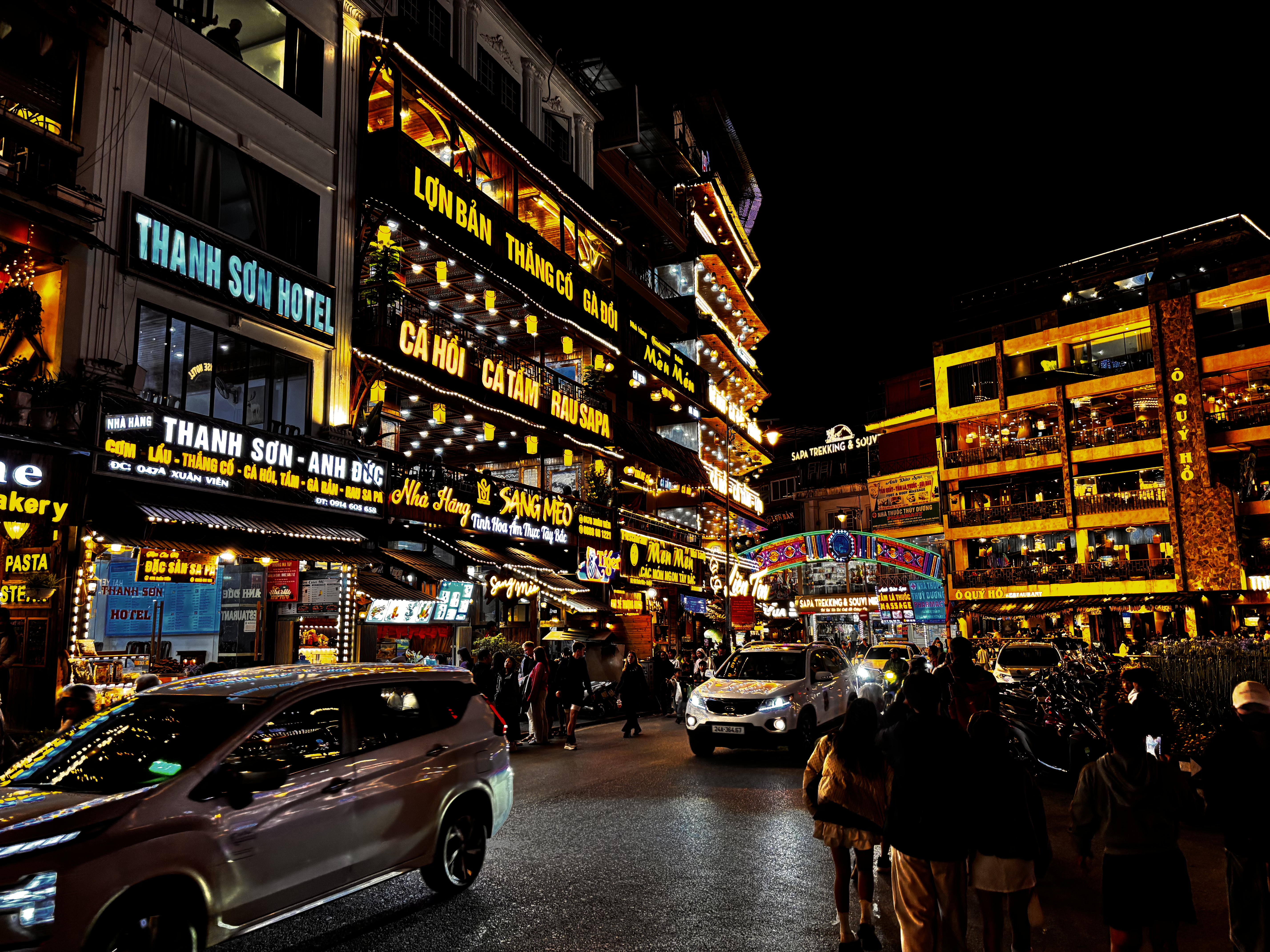
    It is not a coincidence that the buses on the major tourist routes are modern sleeper buses or VIP coaches that are like travelling business class on a flight, these haven’t arrived by coincident. Hotels are all high quality, including the hostels, and as you move around the main centres you find endless trips and attractions on Tripadvisor. After a while the penny drops that these are all quite recent developments, whether it’s the Fansipan cable car in Sapa or Bana Hills near Da Nang, most things have been built in the last 15 years.

    Where the Vietnamese have been super clever has been how the exploit their stunning landscape by creating things that make for brilliant Instagram or Facebook holiday photos, whether it is Train Street in Hanoi or you have to climb a mountain in Nim Binh, there is always the Instagram shot ready made.

    Plate of Vietnamese food with herbs and noodles

    Vietnamese food

    I love Asian food and was really looking forward to this aspect of the trip, but I have to be honest and say that a lot of their food is quite bland. Breakfast might include a croissant, but it wouldn’t taste of anything because it didn’t have the sweet coating, similarly with other meals, we found ourselves reaching for the Soya Sauce to give it some kick as they sauces didn’t have much flavour. It is a far cry from the food you find in Thailand or even your local Chinese takeaway.

    I think it is because they don’t use sugar and salt in the way Westerners use it. 

    Finally, you can’t but love the Vietnamese people. They are so much fun to be around, they are primarily a kind and polite race. To be honest, I’m not sure race is the right word because there are so many different ethnic groupings and something like 50 different local languages still in use. Around Sapa alone there are at least 5 different languages spoken in the villages around that region, as well as Vietnamese, and increasingly, English.

    They are fiercely proud of their heritage and happily talk about beating three super powers, the Americans in the Vietnam war, before that they fought off the Chinese and even Genghis Khan couldn’t defeat the Vietnamese warlords, so they might be fun, but don’t truck with them.

    Hope that provides you with a few hints to plan your holiday.
  • Inca Trail Day 4, the Monkey Steps, Sungate and Machu Picchu

    Inca Trail Day 4, the Monkey Steps, Sungate and Machu Picchu

    After the drama of Day 3 dinner with the guides and the tip issue the night before, we were in bed very early, with only the very brave (or foolhardy) venturing out into the night for the makeshift toilet. The heavy rain on the tent overnight didn’t lift our spirits for the long trek in the dark.

    Day 4 started early, the pots were clanking for breakfast at 2.30am and we were all woken up at 3am for breakfast, which I must admit was pretty hard going but we needed to stock up for a very long day ahead.

    The porters were all over the gear like a rash, packing tents and equipment for their early departure. It later transpired that the porters had to lump everything, including waste of all kinds, back down the mountain to the catch the 6.30am train home. A more motivated bunch I have rarely seen.

    By 4am we were packed up and ready for the trek from Winay Wayna gate to the Inti Punka or the Inca Sungate, or at least to the gate to the national park to start the trek. We loaded up and started down the trail in the dark and the wet, and to my surprise, within 3 minutes we had arrived at the gatehouse. The Winay Wayna camp was right on the boundary to the national park, so we now joined a queue to enter the park, which opened at 530am, talk about anticlimax.

    Luckily, we were one of the first groups to mobilise and were inside the waiting shelter. As the rest of the campsite decamped the queue grew over the next hours to several dozen people, most of whom were stood out in the rain. We were then horrified to discover the gate doesn’t open until 6am, so all this early start was for the convenience of the porters, who had just had a huge tip!

    One of the American lads had picked up a particularly bad stomach bug overnight. We had heard his mate complaining about the noise he was making throwing up, and now in the queue he was laid out on the floor but fortunately improved as time went on.

    It was at this point that we realised how big the risk of a stomach bug is on a trek, because if we had all picked up this bug we wouldn’t have been going anywhere.

    At 6am, the gate to the park opened and after sorting out the tickets we were on our way. The young people seemed to be in a race and hurtled off, but with Wooksie still adjusting to altitude we trundled along at the rear with Todd, who’s knee was reminding him of all the years of basketball abuse it had enduring.

    After 3 days of trekking, the 4th day was tough. It was 2 hours of climbing and staying mentally focused on the prize ahead. Wooksie was starting to struggle with the stomach bug by now, one could only imagine how tough it would be if the bug had developed 2 nights earlier on the trek.

    Dawn bought daylight and more stunning views through the gorges and valleys through which the river flowed. Eventually we arrived at the legendary and dreaded monkey steps, the toughest climb of the trek and the last tough push, the each step was 2 or 3 foot high, and each required a big effort to get up, there were over 100 of the monster steps built by the ancient civilisation, yet another example of their incredible engineering skills.

     If you are young and fit then you can bounce up them but if you were old and suffering with body pains, they are hell. It is a task that requires arms, legs, knees and the occasional helping hand from friends, I scrambled up them OK, Wooksie followed but Todd dropped behind and made it in his own good time.

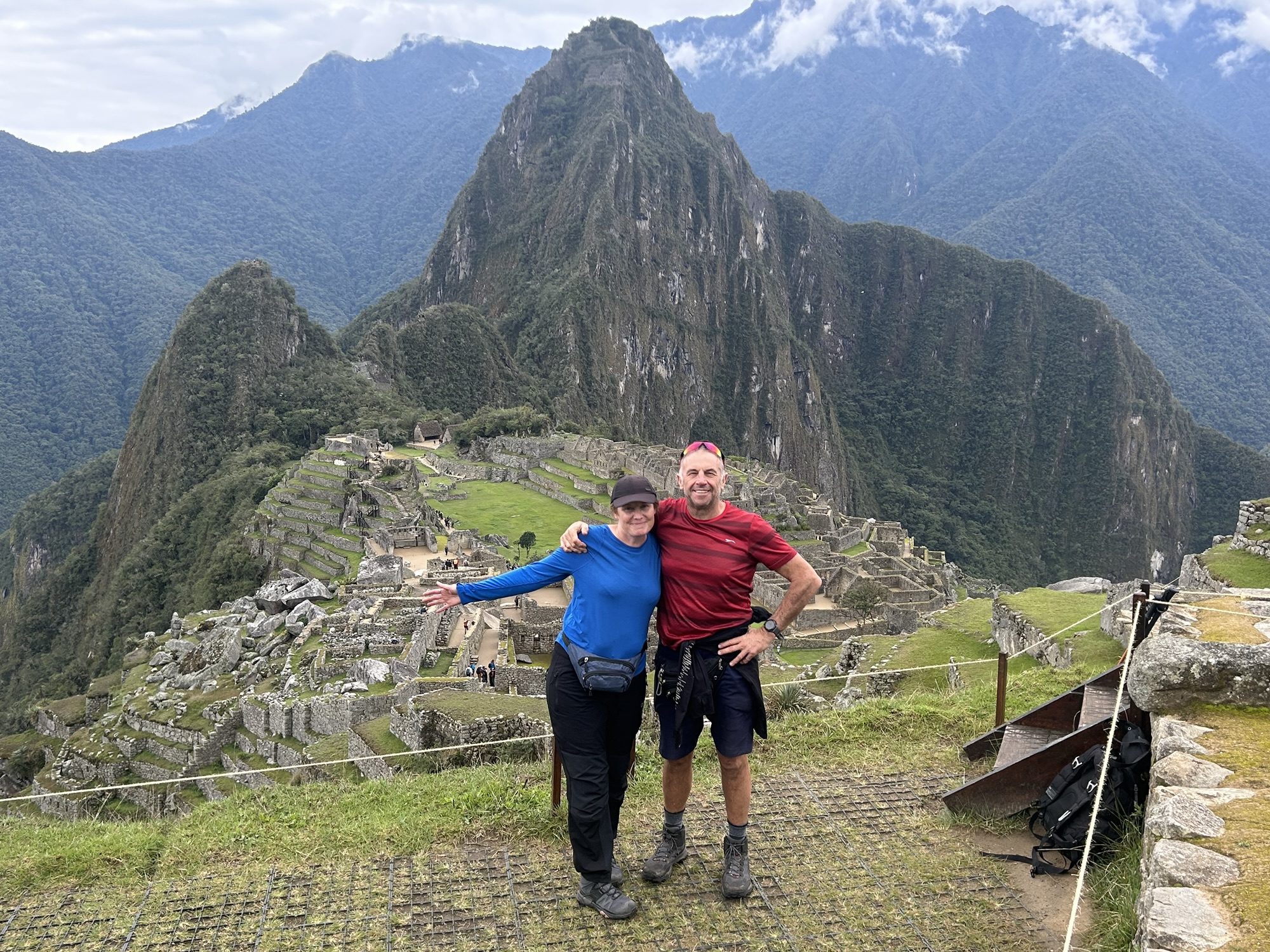
    Eventually, we came over the ridge to look down on Machu Picchu from the Sungate. There was a feeling of elation, I had expected some mythical sunrise but it was past 8am by the time we got there, so we hadn’t made it for dawn, but we had made it and the view was magnificent.

    The next hour was spent getting the Instagram shots done, shaking hands with others and generally enjoying the incredible view from hundreds of feet above Machu Picchu. We then started the much more enjoyable trek down into town, stopping to look at the wild Alpacas but not getting too close, they are cuddly but evil.

    The walk up to the Sungate from Machu Picchu is 3 hours alone, so we were glad to be walking down. As we approached the town the views got better as was the feeling of relief at seeing the end of the adventure.

    On arrival we saw crowds of people queuing for access from for day tickets and many climbing the up the mountain to get a better view of the town. To be honest the day was a bit of a blur, we did a 2 or 3 hours tour of the buildings and infrastructure, but after 4 days of trekking and being up for 8 hours, our energy was lagging.

    The history and splendour of Machu Pichu is like nothing else on earth and you cannot fail to be amazed when you are there. But there is only so many buildings, channels, drains, and terraces that you can take in one lifetime, and by lunch I had reached my fill. The guide who took us around was full of energy, and we tried to be enthusiastic but I’m sure our eyes gave it away.

    I was also very glad we had not taken the additional package to climb little Machu Picchu, peak that is part of the park, the climb up another peak would have been too much, it looked incredible but by now I just wanted to sit down and have a decent meal.

    We were shipped back to Aguas Caliente. Most of our fellow trekkers gathered in the same restaurant and we had a last meal together, chatted about our experiences, how much we needed a comfy bed and it was time to find our train, the one of those that had passed so close by us on the second day and enjoy the trip back to Ollyemptambo and the bus back to Cusco.

    One last thing do not underestimate how much fun the train trip back is. Not only does it have a fantastic glass roof, comfortable seats and people coming around selling coffee and refreshments, you even get a Spanish style guitar band with a trumpet, so there is no chance of sleep until you get on the bus.

  • Inca Trail day 3: Cloud forests, precarious toilets and a tip ambush

    Inca Trail day 3: Cloud forests, precarious toilets and a tip ambush

    Eventually, we wandered into our second campsite. To find the porters had all been busy again, the tents had been built, the canteen tent was laid out ready for dinner and we had bowls of water sitting outside our tents for washing.

    Another smashing evening chatting with our companions, good food and it was time to re-engage with my wandering mattress in the tent for another night chasing it around the tent floor. After such a long period without camping the hard ground started to take its toll so the early morning stretch was getting tougher.

    Same routine with breakfast and then we set off on a long day of climbing. The downside of coming through the valley was that we were way below the altitude needed for the Sun Gate at Machu Picchu. If we had gone over Dead Woman’s Pass we would have been coming down so day 3 would have been the easy part of the journey.

    The Incas were very busy step builders and we were regularly negotiating steep climbs and drops using the stairs they had built 500 years ago. The path meandered along the hillsides, dropping occasionally but it was never any relief, because whenever we went down, we knew we would be coming back up.

    Best scenery of the trek

    The scenery on day 3 was stunning, mostly we climbed through the cloud forest, which is pretty much what it says on the tin, the altitude of the forest means that there are shrouds of clouds in amongst the trees, I guess we would normally call the fog!

    The comradery of our fellow adventurers was great but the strain of the climbing was making an impact on Todd’s knees and he really started to slow up, as did Wooksie who was struggling again as we started to hit altitude, plus the endless steps up through the terraces. The young people didn’t have any of these issues and I made it my business to try to keep up with them, but it wasn’t particularly successful.

    There were some spectacular structures along the route which left us in awe of the Inca ability to turn uninhabitable hillsides into fertile terraces for growing crops of raising animals, probably Alpacas and Lamas.

    Into the afternoon we finally crossed the path coming down from Dead Woman’s Pass which marked the end of the serious climbing for that day. Soon afterwards we were at probably the most impressive of the remote Inca temples and settlements, stunning views, great photo opportunities and an end of the climbing.

    We headed up for the last push to the next campsite only to find that we had actually arrived and it was only 10 minutes away. The porters were busy assembling tents on the terraces and putting the food together for the evening.

    We had a big chunk of the afternoon to ourselves for recovery, which the young people used to climb up some of the trail to Dead Woman’s Pass to prove they had done it, meanwhile, Wooksies decided she would just go and have a lay down, whilst Todd and I went and found ourselves a nice bench and talked about to right the wrongs of the world, and the looking threat of a Trump presidency.
    Precarious Loos

    This was our last camp, and due to it’s location at the end of the trail it was very busy. The conditions were crammed and toilet facilities were at a premium. Each night the porters erected a toilet tent, and tonight was no exception, however, due to the precipitous location of the camp site, the toilet tent was literally hanging off the side of the cliff.

    Going to the loo involved a lot of dexterity, but we had to hang on to the branch of a tree to stop us tumbling down the hillside into the bushes. There weren’t many late night visits to the loo that was for sure, and it wasn’t linked to heavy rain that started to fall during dinner.

    The tipping tradition

    The tradition of treks normally involves a tip for the porters which is collected as a form of thank for their services. In this case it was more a form of extortion, after dinner, the trek leader gave us a grand stand speech on how poor everyone was, and how we were rich.

    The poor old cooks and porters were made to queue up in the rain, and then they were marched in front of us bowing while we applauded their efforts. It was clear that it was humiliating for them and embarrassing for us, in fact, I eventually suggested that they should be allowed to get in out of the rain as they had worked hard enough and didn’t need to be going through this ritual.

    He then told us that we should have separate tips for the cook team and the porter team, and that each trekker should contribute $50 to each of the team, which was $100 each in total. Todd had his family of 7 with in, so in effect he was looking at a tip of $700 !

    It is fair to say that this rather the dampened the atmosphere as nobody was carrying that sort of cash. Between us we clubbed together and created a decent contribution from the group.

    Interestingly, when we did our feedback to Alpaca Tours on the bus home, everyone complained (without any co-ordination) and to be fair we were met in Cusco by representative who worked hard to resolve the problem, but be warned.

  • Inca Trail Day 1 – High drama at the Inca Trail head.

    Inca Trail Day 1 – High drama at the Inca Trail head.

    After the trauma of the altitude issues with Wooksie, we didn’t take the decision to push on with the Inca Trail trek lightly, but we knew this was probably our only chance to do it, but the chances of failure were quite high for Wooksie. We checked into the pre trek meeting in Cusco the night before, looking forward to meeting our fellow adventurers.

    We gathered in the meeting room to find we were travelling with 2 Canadians, 2 Swiss, a Dane and a group of 7 from one US family. During the introductions we discovered the Americans were from Utah and Mormons, brilliant, we were spending 3 days trekking with a bunch of bible punchers – could this get any worse.

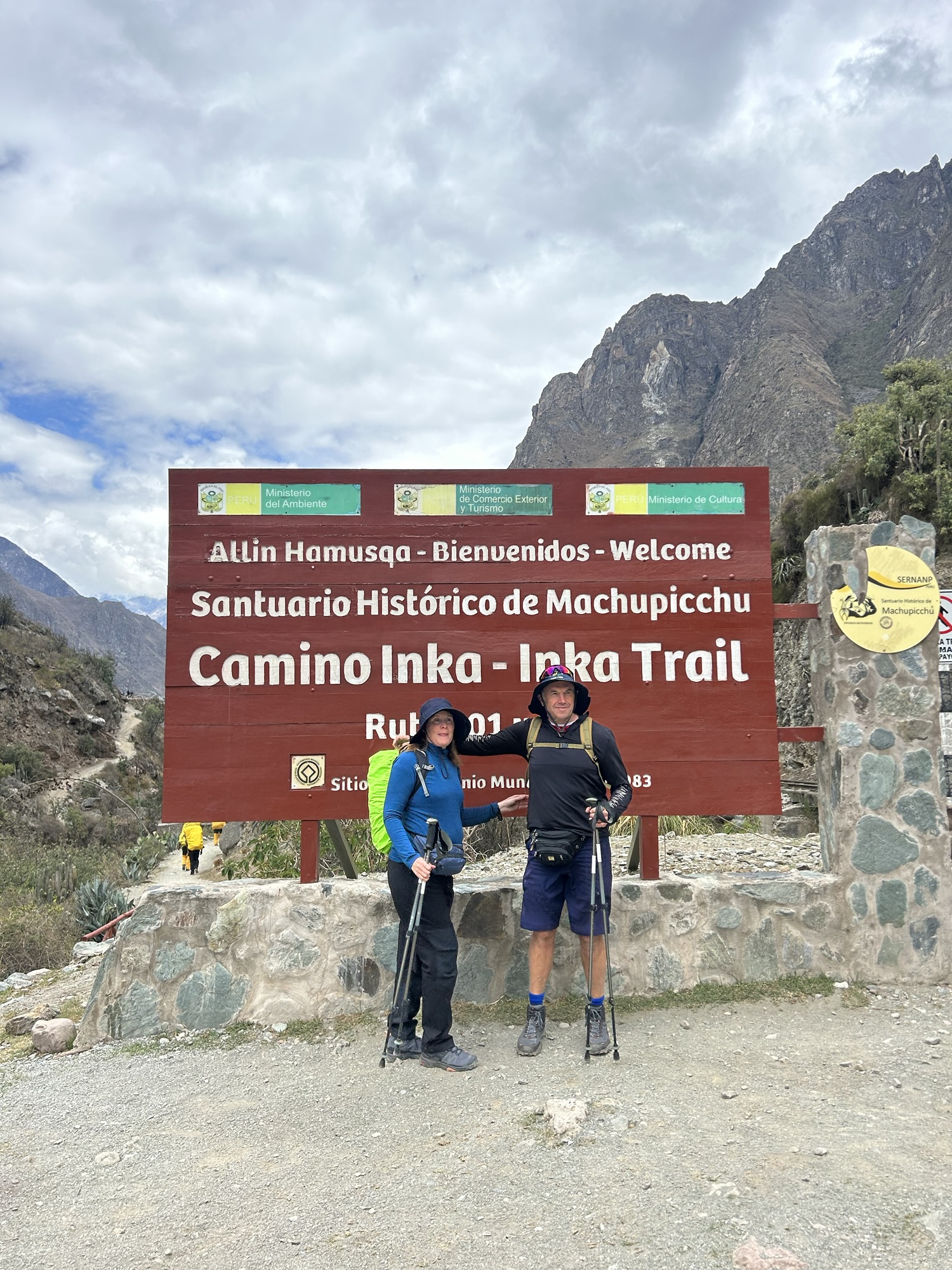
    We confirmed we were all in good health and ready to go, so next morning we were picked up at our hotel at 4am, and headed to Ollantaytambo trail head, the place where all those group photos of enthusiastic people are taken. However, we were one Canadian short, one of them had started to suffer from altitude sickness the night before and decided not to go.

    When we got there it quickly became apparent there was a problem. The guide went to the Wardens office to collect our passes and didn’t come back. We then noticed huddles of guides around the office in deep conversation.

    Our fellow adventurers formed huddles and started to speculate on what was wrong, had someone died on the trail, was there a guide strike, had Machu Pichu collapsed, were the porters on strike?

    Eventually our guide returned, gathered us together and did an athletic leap up on to a table. The trail was closed, apparently this had never happened before, but there had been a fire at high altitude on Dead Woman’s Pass and it was impassable.

    I put my head in my hands in total disbelief, for 22 years we had been looking forward to doing this trek, and the day we get here it is closed for the first time ever, I just couldn’t believe my luck.

    Later when discussing with our fellow trekkers, they all joked about what a desolate image I cut, but it really did feel like my cursed ability to wreak chaos and disasters had caught up with me again. To be honest, it was a bigger disaster for the Americans, who had booked a year in advance, but they presumably accepted it as an act of God!

    It then transpired that the guides and wardens were plotting an alternative option. There was an old trail which went around the mountain rather than over the top through Dead Woman’s Pass.

    Obviously, the trekking company didn’t want to lose the revenue and we all wanted to go, so a plan was hatched to take this alternative route that still delivered us to the Sun Gate to see day break over Machu Picchu on the 3rd morning. There was also a chance that the Pass may open later that day once the fire was under control.

    We set off along the route, which initially takes you alongside the train line that runs to Machu Picchu, we then crossed the river and followed the a relatively gentle trail along the side of the valley. I was amazed at the size of our operation, for every trekker there were at least 2 porters carrying the camping equipment, food and cooking utensils.

    In Nepal the treks used established wooden camps, so I was a bit surprised to see that the entire trek carried it’s own supplies and equipment over the mountains, these little Peruvians were strong!

    After a mile or so we started our first climb up into the hills and it became immediately apparent that we had another problem, Wooksie had been making reasonable progress but as soon as we hit a climb she slowed right down to a crawl, she is a woman of steel and never moans, but I could see in her face she was hurting.

    After a couple of painfully slow ascents, it became obvious that she was in no fit state to climb the Dead Woman’s Pass and that this fire, and the alternative route may have been the luckiest break ever.

    We started to see the failed trekkers making their way back down, individuals that looked like they had been broken by the experience, some walking, some on horseback and in once case, hardly conscious.

    As the day went on, I became more and more grateful that the Pass was closed, in fact my big concern was that they may declare the Pass open. I was watching the guides intently as there was a lot of radio communications going on. One trek was attempting the Pass to see if it was safe.

    We stopped for lunch in a large shed, the timing was perfect as we missed out on walking through torrential rains. Whilst having lunch the pioneer group that had tried the pass came in, it was impassable.

    The fire had burned up the vegetation which binds the rocks together on the mountain side, without the vegetation the rocks were lose and the forces of gravity were causing them to dislodge and cascading down the hillside, so the risk was not the fire but the threat of being hit by a falling rock.

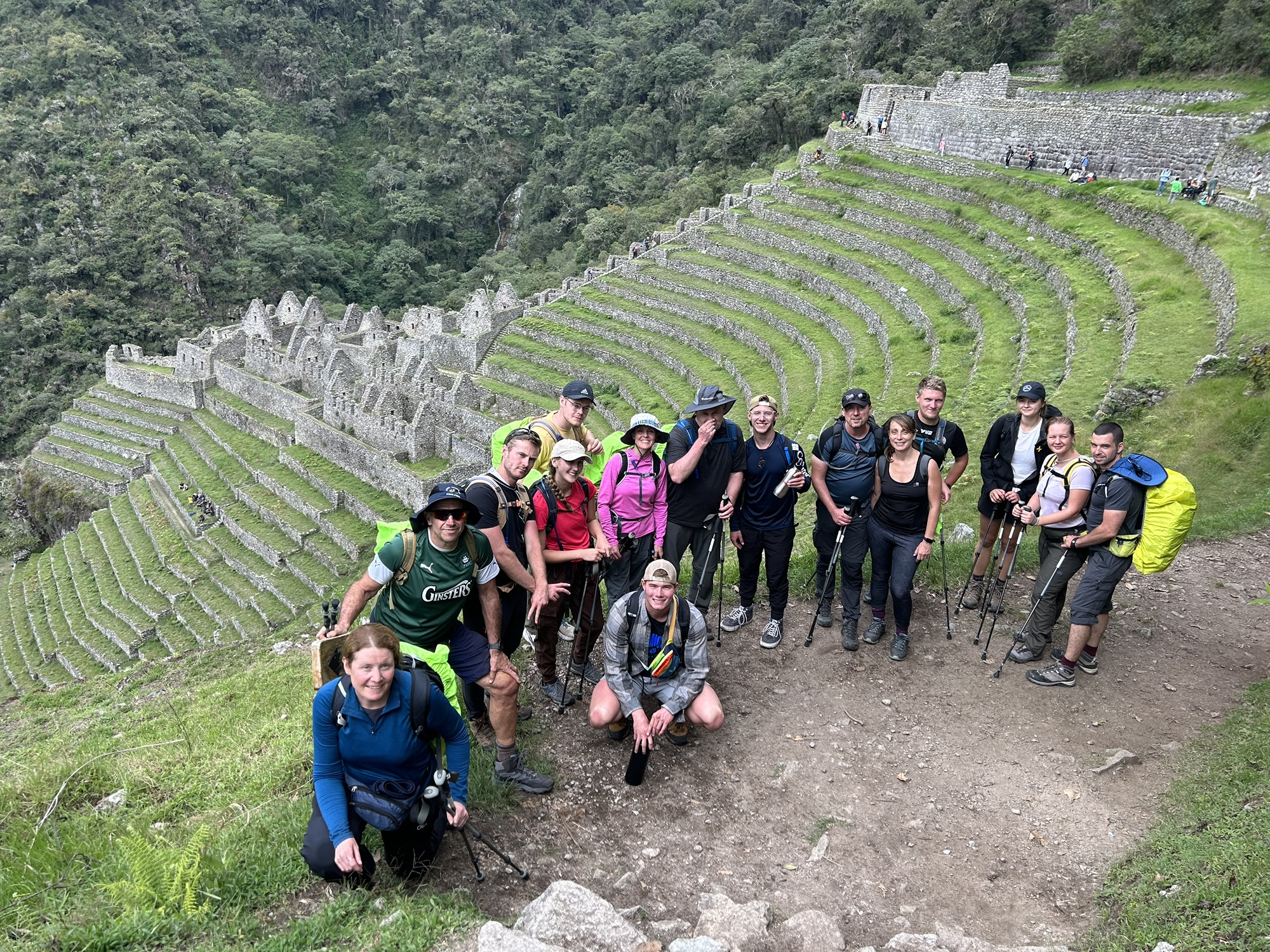
    With this information I was even more grateful we were taking the old route, and after lunch we visited one of the Inca terraced hillsides to amaze ourselves at their engineering and landscape shaping skills, whilst Wooksie rested under a tree. She was getting stronger all the time but not strong enough to climb a mountain and now we knew that she would be able to make it on this lower route.

    Then we headed off for more walking and we made it to our first camp late in the afternoon, 10km covered today, but we knew it would be tougher the next day. One of the best thing about treks is the company of our fellow travellers, our  Mormon companions turned out be really great people.

    It was actually me that invoked the conversations about the Mormon lifestyle and values, unlike the common view of Americans that they are insular, uneducated and don’t travel, these guys travelled a lot. The grown up children had all been missionaries in Central America or Africa, were really well educated, and seemed to be able to talk about anything, so were great companions.

    At the end of the  trek I was left reflecting how our drift away  from religion  meant we had lost many  good  values.

    That night, the porters set the tents up, set up the canteen and cooked an amazing meal then challenged the walkers to a football match, which we declined !

    We had a great time chatting with the others over dinner. Some of the younger trekkers  were very disappointed about missing out on the climb, but Todd, the father of the  Mormon family was struggling with a bad knee and Wooksie were relieved, I’m not sure either of them would have made it.

  • The incredible Sacred Valley of the Incas

    The incredible Sacred Valley of the Incas

    Next up on our adventure was a day tour of the Sacred Valley of the Incas.  In many ways this was the most amazing tour of the holiday as we saw many of the Inca sites, everyone thinks about Machu Picchu but the Incas were very busy around this region and this tour picked up many of their structures. I’d say I learned more on this trip than the Inca Trail, that is how good it was.

    One of the problems with the Inca history and previous civilisations, is that they couldn’t write. Unlike the West where we have written or documented history from the Egyptians and other early civilisations, nothing like that exists for Peru and written history is largely attributable to the Spanish conquistadors, and only a limited number of academics who wanted to preserve their legacy.  

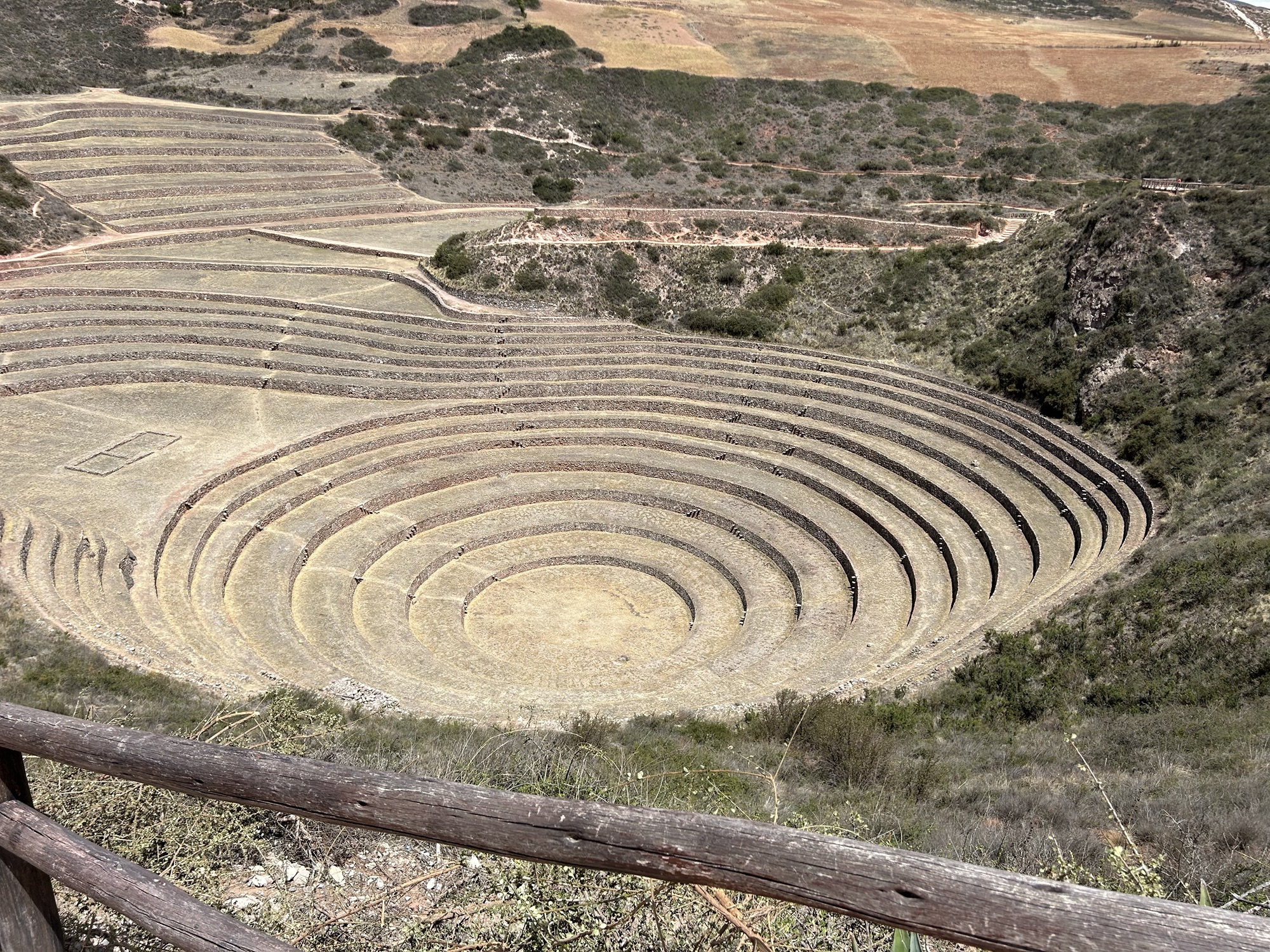
    There were a couple of highlights of this tour, the first was the amazing, terraced valley near Pisac. As a geographic spectacle it is stunning, as you stand at the top of the valley it is difficult to believe ancient people could have turned a valley into this terrace. Even more amazing was the scientists, belief that the terraces were used as a biological observatory to test the ability of plants to survive at difficult altitudes.

    The Incas were basically engineers, they build incredible walls with amazing scientific accuracy in the angle of the walls to ensure their stability.  The thing we learned over our time in this valley was that the terracing of the valley was the only way it could be inhabited.

    The walls of the valleys are so steep with unstable rocks that the only way to flourish in the valley was to create stability and that is why  the Incas built all the terraces.

    We then moved on to an amazing terrace of salt pools, this too dated back to the Inca civilisation, they had spotted that the underground river was carrying salt and built these pools to trap them. This is still a commercially viable site and one of the big products is, surprisingly, chocolate.

    Then we headed to Ollantaytambo this little town was the place that the train to Macchu Pichu leaves from, and also the trail head for the Inca Trail trek.

    This little town had an amazing, terraced structure of it’s own, called the Temple of the Sun and on the other side of the valley there were tombs built into the mountain rock face that were hundreds of feet above the valley floor. It was very difficult to imagine how people climbed up the rock face along narrow paths to build these structures way up on the rock face.

    We then set off to climb the terraced temple, which was steep but nothing compared to what was coming on the Inca Trail. it was then that I noticed that Wooksie was struggling, she had been recovering nicely and was getting back to herself at the lower altitude, but clearly when put under strain it became very difficult and we were still at a much higher altitude than normal

    So a long drive back to Cusco, a very well organised tour and if you only have time for one tour I would say this is the one, you don’t see Macchu  Pichu but you do really get an impression about the amazing the Inca nation before the Spanish eradicated it in their search for gold, fortunately, some of it was documented. 

    With Wooksie still struggling we had a very difficult decision ahead of us. The Inca Trail had been booked 6 weeks before, postponement wasn’t an option so our decision was “go” or “no go”. We had another quiet day in Cusco mooching around the museum and taking it easy to help Wooksie recover.

    A tough decision in our world always comes down to the same question, “What’s the worst thing that could happen”, and that is where we got to with the decision on the trek. Wooksie wasn’t really up to it, but we had the option of completely cancelling or giving it a go. We concluded that we were better off giving it a go and if it didn’t work out, we would just have to pull out of the trek and the costs of being extracted.

    So we committed to going and turned up the pre trek meet that evening, but we weren’t feeling particularly confident – onwards and upwards, although the name of the high altitude pass, Dead Woman’s Pass, wasn’t exactly encouraging.