

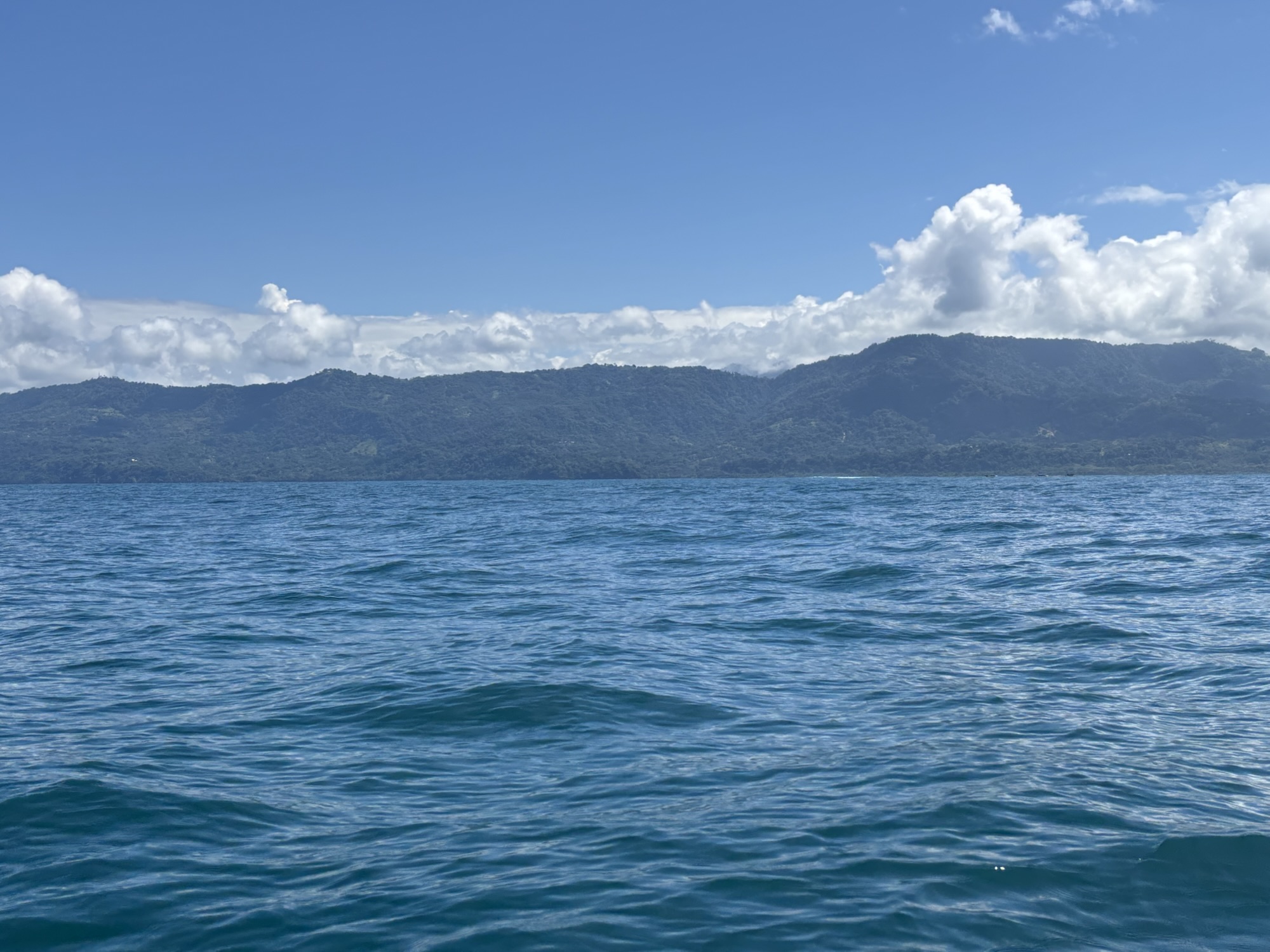

To be honest we weren’t sure if the Sowdens had ever seen a whale or not. We might have seen one off Byron Bay in 1997, but my memory was that we might have been a bit optimistic seeing a whale blow in a choppy sea on a windy day from the road, so this was an opportunity to seal that deal and see a whale. We certainly hadn’t been on a whale spotting trip before, so it was a first.
Hopes for spotting whales were high
It is the middle of whale migration season so hopes of spotting Humpback whales on their long journey from the northwest coast of the US to Antarctica. In fact, the guides were so confident they were putting it at a 90% chance of spotting them, so we were quietly confident of scoring our first whale sighting.

Uvita is a national park. It has a beautiful coastline where the beach mingles with the jungle in a spectacular way, and there is also a unique headland called the “Whale Tail”. At low tide there is a causeway that is exposed, this leads out to a reef of rocks about 500m off the beach.

Visit to the Whale Tail
I tried to walk out there one afternoon, but the rocks at the end of the causeway were a bit too sharp for my delicate feet so I didn’t make it all the way. The Humpback whale migration is the reason that it is a national park, apparently this enables the government to control fishing and other commercial activities to protect the whales.

The day started well, waking to a lovely sunny morning, we met at the trip centre at 8am for a breakfast and coffee. We were then put into groups and marched down to the beach to board the boats. When we arrived, we gathered at the water’s edge ready to board the high speed launches to go whale hunting.
All aboard the Whale flyer
As we boarded the boat, the skipper gave us lots of useful information about sitting at the rear of the boat to avoid seasickness. Despite this, sadly a few people had a really rotten morning and missed out on the pleasure of watching the whales, luckily Wooksie and I weren’t part of it.

We got off to a flyer (literally in that boat) and within 10 minutes we were on the trail of the whales about a kilometre off the beach, near a reef exposed at low tide. The first sighting is very exciting and everyone on board is scrambling over each other to get the first glimpse, and it was spectacular.
Whales ahoy
Not just one whale, but a mum followed by her calf, gliding through the sea not far from the beach. There was a boat out there before us and they spotted the whales. They enjoyed some great views as they ran along beside the creatures and our boat kept a respectful distance so not to crowd the whales and their watchers.

The skipper tried second guess where the whales would surface from their dive and position the boat in pole position. As we all looked in the direction of the other boat where the whales should have appeared a different pair of whales surfaced on the other side of the boat. Unbelievably, there was a second pair of mum and calf swimming in the same area within a few hundred metres of each other, so we had these wonderful creatures all around us.
Before we knew it, we were also surrounded by boats as well as the other whale watching trips launched from the beach and headed to where all the action was, around our boat!

I guess the best analogy would be like a posse of paparazzi hunting a celebrity with a load of fans onboard as well.
To be fair, there are strict rules around the number of boats that can be actively whale watching at any one time. The various skippers are all trying to get the best views for their passengers and rarely got close to the other boats. They certainly gave space to the whales, but of course, it is difficult to know where they are going to rise next.
After the initial excitement we settled down to an entertaining morning of whale chasing. The two mums and their calves carried on their sedate journey towards Antarctica, and we headed north along the coast in search of their fellow travellers. It wasn’t long before we found more, mostly singles but it was common to find mums and calves travelling in tandem and apparently teaching the calves to rush clear of the water, breaching as it is known.
As the skipper of the boat observed, we are all hoping for our National Geographic moment when the whale breaches and we got lucky with this shot of the young whale breaching just off our bow.

In truth, you spend a lot of time staring at an empty ocean waiting for something to happen, but with your camera poised and ready for action. From the boat, we could only get the side perspective of the whales and sometimes the two creatures together, what we miss is the sheer enormity of the creatures that can only be seen from above, so I have borrowed this photo from Google to help illustrate what we can’t see.
Breaching Humpback whale
Humpback whale sightings
I have assembled all the clips of the whales into one video that tells the full story of the day and includes all the sightings that we had during the day. The thing to remember is that we are seeing these creatures’ side on, viewed from above they are vast, it is like looking at the tip of an iceberg from the side.
It wasn’t just whales that came out to see the passengers. We had a visit from a small pod of Tropical Dolphins who tracked our boats for a good 5 minutes surging alongside the boat and cutting across the bows apparently just having fun.
Dolphins ahoy
Over sexed turtles
Then we had an unexpected sighting of two copulating turtles. I spotted this blob in the water off the bow of the boat, in fact, I initially thought it was a dead fish that had been hit by an outboard engine. On further examination it was two turtles who were so engrossed in their activity that they were floating around on the surface of the ocean physically and emotionally attached, I guess that in reality this is a turtle porn movie. There is no danger of turtle extinction if they carry on like this.
Stunning coastal scape
We then headed back along the coast to look at a rather unique cave eroded through a headland. We had seen one of these in New Zealand where they drove the boat through the cave, but no such excitement here. Unbeknown to the crew of the boat and the other passengers, I had studied these formations during GCSE geography at Widey Tech school back in 1975, and these formations are caused by an erosive process called subaerial denudation, not many people know that, but my geography teacher would be very pleased to know that I been paying attention and remembered the term.

The trip concluded with a trip to another island where we had a nice snack of fruit, and an opportunity for people to jump over the side and bob about in deep water for no apparent reason, maybe it was just to cool off.
This felt a bit of an unnecessary extension to what had been a spectacular morning seeing these amazing creatures.
Leave a Reply